Showing posts with label racism. Show all posts

Monday, 26 May 2014

Uncomfortable History: Racism and the Komagata Maru Incident


In Canada, we often like to slap our own backs a lot about how multicultural we are, how accepting we are of other peoples. Heck, since 1971 when our government declared multiculturalism a state goal, we've been saying how awesome we are.

Let's not forget our racist, imperialist past. 

Officials board the Maru 1914 - Vancouver Public Library
A hundred years ago this week, Canadians denied a ship load of immigrants because they were not white and they might be supporters of independence in Indian.

On May 23, 1914, The Komagata Maru from Hong Kong carrying 376 passengers, most being immigrants from Punjab, British India, arrived in Vancouver's Burrard Inlet. They wanted to challenge the Continuous Passage regulation, which stated that immigrants must "come from the country of their birth, or citizenship, by a continuous journey and on through tickets purchased before leaving the country of their birth, or citizenship." The regulation had been brought into force in 1908 in an effort to curb Indian immigration to Canada.

Why no Indians in Canada? To quote the 1923 Immigration Act, the desirable immigrants were in these two categories:

a) "Preferred Category": British and Americans, West Europeans. Example: the Empire Settlement Scheme, 1923.
b) "Acceptable Category" (although not "preferred"). immigrants in "sheep-skin coats". East Europeans (Russians, Ukrainians, Poles); South Europeans (Italians, Greeks, Spaniards). If they go West and farm, they will be accepted although considered "foreign", as long as they know "their place".

As a result, the Komagata Maru was denied docking by the authorities and only twenty returning residents, and the ship's doctor and his family were eventually granted admission to Canada. The ship was then escorted out of the harbour by the Canadian military on July 23, 1914 and forced to sail back to Budge-Budge, India where nineteen of the passengers were killed by gunfire upon disembarking and many others imprisoned.

What is rarely focused on in the may sources is the human drama unfolding and why would they even try to come to Canada, knowing they might be turned away. What makes people so desperate?
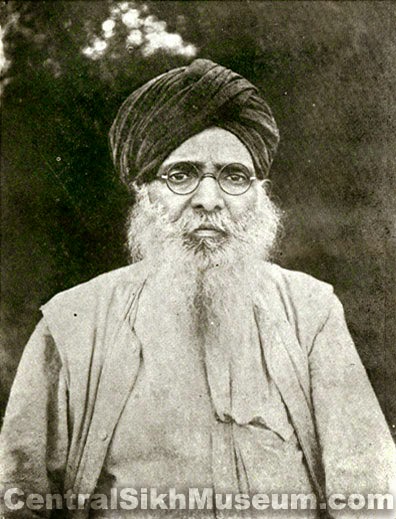
Baba Gurdit Singh - a nice man who clearly had enough
These were British subjects, but many were under the scrutiny of the British government. At the time in India, the call had gone out for independence. Some men on the boat were members of the Ghada Party. They conducted revolutionary activities in central Punjab and attempted to organize uprisings against the British overloads.

One member was Gurdit Singh. In 1911 he raised his voice against forced labour. He wrote to the Government complaining against officials who forced poor villagers to work for them without remuneration, and when he received no response, he exhorted the people of his village to refuse to be subjected to forced labour.

He's the one that chartered a Japanese ship, Kamagata Maru in 1914 to go to Canada.The obstructions put up by the alien authorities and the hardships faced by its passengers turned them into staunch nationalists.When it was turned back and reached Calcutta, the passengers were not allowed to enter Calcutta, they were rather ordered to board a Punjab-bound train especially arranged for the purpose. They refused to do and many of the passengers were shot dead. Gurdit Singh escaped and remained underground for many years till in 1920 on the advice of Mahatma Gandhi he made a voluntary surrender and was imprisoned for five years. After his release he settled down at Calcutta where he died in 1954.
Why did he do what he did? One quote sort of lets us know:

Memorial in Punjab to the people and to Singh
“The visions of men are widened by travel and contacts with citizens of a free country will infuse a spirit of independence and foster yearnings for freedom in the minds of the emasculated subjects of alien rule.”
~ Gurdit Singh

Sunday, 11 May 2014

The Golden Naked Man and the Blackface Singer: The History of Blackface


This week I've been so busy with working at my library job and taking care of a sick aunt that history has been very far from my mind, until I saw this:

No. I don't care if you're wearing a suit, it's still not cool
This is from the 1927 film The Jazz Singer. Other than spitting out my tea as a man in blackface showed up, the film was quite good. The story of a Jewish man who becomes a great singer and finally wins respect is touching, if only not for the "Mammy" blackface song. Wow.

At this time, sound had just been introduced into film. The Warner Bros. movie The Jazz Singer-one of the first "talkies"-was not allowed to compete for Best Picture because the first Academy Awards committee decided it was unfair to let movies with sound compete with silent films. It did win a special production award, and two Academy Awards for Adapted Screenplay and Special Effects.

They had no problem then with what I consider personally the most bizarre thing I've seen since last week's movie viewing:
Yes I did watch it - sorry good taste, I know you'll never forgive me.
The whole black face thing began way back in theatre makeup. Remember the play Othello? There were no black actors in Elizabethan England so a white guy had to make himself up as a Moor. It was very common in European theatre after the 1700s that actors would put on ethnic makeup for shows. But the real increase in racist characters inflated in the United States, because beating down people you had as slaves is always a good idea. They created the Minstrel shows, where whites would sing African-Irish fused folk songs as black characters. Thomas Dartmouth “Daddy” Rice developed the first popularly known blackface minstrel character (“Jim Crow”) in 1830. The shows travelled over to England where their popularity grew.

Yum, chocolate?
The University of Southern Florida has a great special collection online that puts it all in context: why when the movement to abolish slavery was blackface so popular? It states:

"It may seem strange and ironic that abolitionists helped popularize blackface performance and black stereotypes, but minstrelsy tapped into a much wider audience than anti-slavery pamphlets, books, or speeches. Starting in 1832, Thomas Dartmouth “Daddy” Rice took his Jim Crow act from New York to London, kicking off a craze for minstrel song and dance. Abolitionists on both sides of the Atlantic seized upon this new format, including burnt-cork blackface, to promote the end of slavery. In one of Rice’s songs, the master of a slave named “Gombo Chaff” went to Hell after he died, where he was forced to perform the menial tasks he assigned to his slaves."

One other crazy thing happened before the age of minstrel shows died out: African-Americans performing all the minstrel songs. Unlike the majority of white blackface performers in the 1800s who were born in Northern cities prior to the Civil War, most African American blackface minstrel performers were born after the Civil War and in Southern cities. The differences between white and African American minstrel performers do not stop there. Although the age of urban industrialization brought great opportunity for whites in America, according to Karen Sotiropoulos, “for black Americans, the 1890s ushered in a decade of shrinking possibilities, and artists and activists alike desperately sought any avenue for advancement.

Yup - even Judy Garland int he 1930s did it because this is really how African Americans look.
By the early 1900s, people were still fascinated and watched blackface being performed by men and women, and accounts for the popularity of The Jazz Singer. The singer and actor Al Jolson rocketed to stardom with this movie with his music and face paint, becoming a house hold name. So painting your face like a black person and singing songs was popular up until the 1930s when awareness of human rights and the 1960s civil rights movement began.

If you think that blackface completely died out with the end of segregation in the US, you'd be wrong. Thanks to those "I think minstrel shows are cool" British people, The Black and White Minstrel show (1958-1978) was a singing and dancing show. It was extremely popular, until people noticed that it was really racist and finally made the BBC cancel it.
Because the sequence was the most offensive thing here.
 Unless a performer is doing some sort of historical retrospective, being in blackface is very rarely seen...except in Hollywood and the music industry. The controversy came back in 2008 with Tropic Thunder, where Robert Downey Jr. portrays a Australian method actor named Kirk Lazarus who immerses himself so thoroughly in his role as a gung-ho black sergeant that he undergoes what the script calls a "controversial procedure" involving pigmentation alteration. While I get that the film makers were trying to satire blackface, it still is a creepy thing to watch. Just like people in whiteface, yellowface, redface...sigh.

A dude playing another dude...