Showing posts with label History. Show all posts

Wednesday, 18 May 2016

A Very Late Apology: The Komagata Maru, Canada and Racisim


Today, something happened. Canada said sorry...again. For another bad screw up. This one has been 102 years in the making.
As reported by the CBC:
Nearly 102 years after the Komagata Maru sailed into Vancouver, Prime Minister Justin Trudeau has offered a full apology in the House of Commons for the government of the day's decision to turn away the ship, which was carrying hundreds of South Asian immigrants, most of whom were Sikhs.
The Komagata Maru arrived on Canada's West Coast on May 23, 1914, anchoring in Vancouver's Coal Harbour. Nearly all of the 376 passengers were denied entry and the ship sat in the harbour for two months. It was ultimately forced to return to India and was met by British soldiers. Twenty passengers were killed and others jailed following an ensuing riot.
The Maru was a Japanese steamship chartered by wealthy Sikh businessman, Gurdit Singh, who was then living in Hong Kong. Its passage was a direct challenge to Canada's immigration rules, which had grown increasingly strict — and discriminatory — at the turn of the century. 
Canada needed immigrants to cultivate western farmland but preferred those from the U.S, Britain or northern Europe. 
India had been a British colony for almost 200 years at this point, and Singh believed British citizens should be able to freely visit any country in the Commonwealth.
Komagata Maru passengers
Passengers from the Komagata Maru, shown in 1914. (James L. Quiney/City of Vancouver Archives) Too bad if you think you're all equal to us superior white people...oh...you did...this is awkward...
The steamship departed Hong Kong on April 4, 1914, making stops in Shanghai and Japan. Previously used to transport coal, the Komagata Maru had been transformed for the long journey.
Word of the ship's intended destination quickly reached Vancouver, where anti-Asian sentiment was already in full swing. Local newspaper headlines of the day decried its arrival as a "Hindu invasion."  Yeah - like Hindus and Sikhs are the same...
In Vancouver, the Komagata Maru was immediately greeted by immigration officials who refused to let its passengers disembark. Twenty people determined to be returning residents were eventually permitted entry, but no one else stepped foot off the boat.  
For two months they sat there. Eventually, they gave up and headed back home to Calcutta. Where they were promptly arrested, and 20 people were killed. Thanks Canada.
li-komagatamaru-620

Party Boat? The Komagata Maru sits in Vancouver's Coal Harbour in 1914. The ship became a spectacle for locals during its two-month stay at the waterfront. 
The Prof. Mohan Singh Memorial Foundation, founded in 1990, has been lobbying for an apology for nearly 25 years, working with local, provincial and federal politicians.
Finally, after everyone is dead, Canada gets around to apologizing. While I am glad of it, and for my Sikh friends, it's a typical move by our country to apologize for being shits to certain groups of people long after the fact. I have an idea: maybe we should stop being racist shits. Maybe?

Thursday, 28 April 2016

History News: 'Lost' Medieval Music Performed for First Time in 1,000 Years

I'm a huge classical and ancient music fan, which is code for geek. Big news then for me is that a lost piece of Medieval music has been reconstructed and performed. After a 20-year reconstruction effort, Sam Barrett, a senior lecturer in music at the University of Cambridge, has brought "lost" songs from the Middle Ages back to life.

Get down, get down, and bring the house down.


Reported by LiveScience writer Kacey Deamer, the "Songs of Consolation" were recently performed at the University of Cambridgein the United Kingdom. Reconstructed from "neumes" (medieval symbols used to represent musical notation), the tunes accompanied poems from Roman philosopher Boethius' magnum opus, "The Consolation of Philosophy."
A millennium ago, music was written in melodic outlines and not the modern "notes" that musicians rely on today. Music in medieval times was then shared through aural traditions and musicians' memories. Since these traditions died out hundreds of years ago, it is nearly impossible to decipher music from this era, because the pitches are unknown, experts have said.
Sam Barrett, a senior lecturer in music at the University of Cambridge, spent the past 20 years painstakingly identifying the musical techniques and melodies for "Songs of Consolation." He then worked with Benjamin Bagby, a member of Sequentia, a group of performers who have built a working memory of medieval song. Together, the two tested theories of the music with practical accompaniment.
"Ben tries out various possibilities, and I react to them — and vice versa," Barrett said in a statement. "When I see him working through the options that an 11th-century person had, it's genuinely sensational; at times you just think, 'that's it!' He brings the human side to the intellectual puzzle I was trying to solve during years of continual frustration."
The researchers faced one major hurdle in their reconstruction project: a missing page from an 11th-century manuscript called "Cambridge Songs," the final part of an anthology of Latin text. The lost page included vital notations used to understand the musical principles of the era.
Barrett said the notations allowed him and Bagby to "achieve a critical mass" that may have been impossible without that puzzle piece. 
"There have been times while I've been working on this that I have thought I'm in the 11th century, when the music has been so close it was almost touchable," Barrett said.

Check out the tune here on You Tube. Beautiful!

Sunday, 24 April 2016

High Plains Drifter: Revisionist History in Wraith Form

I've been so busy with the two theatre companies I'm involved with, that history had taken a back seat. Well, here I am in the saddle again, and what better way than to write on my favourite supernatural western - High Plains Drifter.

High Plains Drifter poster.jpg
And don't forget there is no historical accuracy.

Yep, that's what I said: Supernatural Western. They are rare but this one is the best in my opinion. Eastwood plays a wraith that is looking to payback the townspeople who didn't help him as three men whipped him to death. It's a gritty, dark film that I first saw at the age of 12. Which explains my love of revenge movies and westerns. Even then, I knew this was revisionist history: the real American Western frontier was rough but it was more about colonialism than shoot em ups.

The Real American West


High Plains Drifter is a film about one white town in California sometime around the 1870s. People are still screwed up from the huge changes: completion of the railroads to the West following the Civil War opened up vast areas of the region to settlement and economic development. White settlers from the East poured across the Mississippi to mine, farm, and ranch. African-American settlers also came West from the Deep South, convinced by promoters of all-black Western towns that prosperity could be found there. Chinese railroad workers further added to the diversity of the region's population. These two groups are missing from the film, but some Mexican men who are treated very kindly by Eastwood are present. Their stories, however, are  not explored as they are background characters. 

The Library of Congress says that this time period, while pivotal in the creation of the USA as we now know it,  was not a win-win for everyone:

Settlement from the East transformed the Great Plains. The huge herds of American bison that roamed the plains were virtually wiped out, and farmers plowed the natural grasses to plant wheat and other crops. The cattle industry rose in importance as the railroad provided a practical means for getting the cattle to market. 
The loss of the bison and growth of white settlement drastically affected the lives of the Native Americans living in the West. In the conflicts that resulted, the American Indians, despite occasional victories, seemed doomed to defeat by the greater numbers of settlers and the military force of the U.S. government. By the 1880s, most American Indians had been confined to reservations, often in areas of the West that appeared least desirable to white settlers. 

I Wanna Be A Cowboy


By the middle of the 1870s, the term “cowboy” described the young mounted riders driving cattle out of Texas. This term was originally used east of the Rocky Mountains; the preferred term on the other side of the Great Divide was “buckaroo,” coming from the Spanish word for cowboy, vaquero. But this did not last for long. By the early 1880s, bolstered by the mostly mythical image of the “wild west” portrayed in dime novels, the love affair between the general public of North America and Europe and the “cowboy” had begun.
The cowboy became the symbol for the West of the late 19th century, often depicted in popular culture as a glamorous or heroic figure. The stereotype of the heroic white cowboy is far from true, however. The first cowboys were Spanish vaqueros, who had introduced cattle to Mexico centuries earlier. Black cowboys also rode the range. Furthermore, the life of the cowboy was far from glamorous, involving long, hard hours of labor, poor living conditions, and economic hardship.

And no women to dance with. But I wonder if some didn't mind so much,as the source FairClassrooms points out.

The myth of the cowboy is only one of many myths that have shaped our views of the West in the late 19th century. Recently, some historians have turned away from the traditional view of the West as a frontier, a "meeting point between civilization and savagery" in the words of historian Frederick Jackson Turner. They have begun writing about the West as a crossroads of cultures, where various groups struggled for property, profit, and cultural dominance. 

So, in High Plains Drifter, there is no gay cowboys, no Indians, no Chinese, no African Americans...no historical accuracy. It's pure fantasy and myth building, and it's fun. Or is it a bad thing? All this violence is very self-indulgent I admit.

In the ongoing historical analysis, the culture of violence in the American West of the late nineteenth century was created almost entirely by the U.S. government’s military interventions, which were primarily a veiled subsidy to the government-subsidized transcontinental railroad corporations. Should we point out the controversial genocide against the American Indians that's happily ignored in every film? (Controversial because was it intentional or just a "happy coincidence?")

But the one part they do get right is the need for a bath. Eastwood's character needs one and a shave. You can just see the stink coming off him. I'm sure the bath scene made my mom swoon though.

I'm a very dirty cowboy...

Monday, 4 April 2016

New Viking Settlement In Canada Located- Pointy helmets not found yet

The internet is exploding with news of a new Viking site in Canada.

Otherwise, it's all about an epic text conversation over boyfriend buying makeup for his girl. ZZZZZZZ


Archaeologists have used satellite imagery to identify a site in Newfoundland that could be the first new Viking site discovered in North America in over 50 years.

Satellite imagery, magnetometer surveys, and a preliminary excavation of the site at Point Rosee in Southern Newfoundland last year could point to a potentially fascinating discovery.

Until now, Newfoundland has the only Viking site in North America, found in the 1960s at L’Anse Aux Meadows on the northern tip of Newfoundland, about 300 miles from Point Rosee.

Discovery News online reports that the new site was identified by Archaeologist Sarah Parcak of the University of Alabama, Birmingham, used high-resolution satellite imagery to spot ruins as small as 11 inches buried below the surface:

From Discovery. To the trained eye it still looks like..a mossy bog.

The archaeologists’ investigation will feature in “Vikings Unearthed,” a special of PBS’s NOVA science series, co-produced with the BBC, that premieres online on April 4. The special will air on PBS April 6.
Satellites positioned around 478 miles above the Earth enabled Parcak and her team to scan a vast section of America and Canada’s eastern seaboard.
The satellite images, two magnetometer surveys, and preliminary excavations suggest “sub-surface rectilinear features,” according to the experts, who also identified possible evidence of ironworking in the form of roasted iron ore. Radiocarbon technology has dated the site to between 800 and 1300 AD. 
The project was led by Parcak and co-directed by Gregory Mumford, an associate professor at the University of Alabama at Birmingham and Frederick Schwarz, of Black Spruce Heritage Services. Douglas Bolender, an archaeologist at the University of Massachusetts, Boston, and historian Dan Snow also participated in the investigation.
Less in the middle of Nowhere, Newfoundland than the other one as the ferry dumps you off in Port-au-Basque.


We all know that the vikings brought the fun in New-Fund-land...ok bad attempt at pun. But the fact that if this data is confirmed as Norse by further research, the site will show that the Vikings travelled much farther in North America than previously known, pushing the boundary of their explorations over 300 miles to the southwest.

And another tourist site for Newfoundland to promote the hell out of.


Sunday, 24 January 2016

Too Bad For You: It's A History Holiday In Cambodia!

Sign me up for this. From Beach Cambodia
This week on the " Historical Places I Can Never Go" list is one I have cherished for a long time. When I was young, many of my friends were immigrants, and many were from Cambodia. I never asked why they came to Canada, but I assumed that the whole French Resistance/Killing Fields/Khmer Rouge/Vietnamese thing had a lot to do with them fleeing in the early 1980s. I hope that one day the lovely people of Cambodia will get to have peace and fat tourists coming to spend money in their country. Again, I don't hold my breath.

According to the Cambodia Tourism website, it's the "kingdom of wonder. There's lovely buses to take tourists to lovely places and see their lovely historical and artistic places. And that's true. It looks incredible.

Cambodia also has two UNESCO World Heritage Sites: Angkor and Temple of Preah Vihear.
The City of Angkor. Copyright UNESCO. So don't steal it.
Angkor is an "important archaeological sites in South-East Asia. Stretching over some 400 km2, including forested area, Angkor Archaeological Park contains the magnificent remains of the different capitals of the Khmer Empire, from the 9th to the 15th century. They include the famous Temple of Angkor Wat and, at Angkor Thom, the Bayon Temple with its countless sculptural decorations." But these awesome faces are also being eaten by trees. Because the forest just does not give a shit.

One of the trees pulling a Cthulu on a sculpture at Angkor Wat. Mmmmm...history is yum.


Temple of Preah Vihear, and this is a bad picture compared to what else they have. Copyright UNESCO

The Temple of Preah Vihear is "dedicated to Shiva. The Temple is composed of a series of sanctuaries linked by a system of pavements and staircases over an 800 metre long axis and dates back to the first half of the 11th century AD. Nevertheless, its complex history can be traced to the 9th century, when the hermitage was founded. This site is particularly well preserved, mainly due to its remote location. The site is exceptional for the quality of its architecture, which is adapted to the natural environment and the religious function of the temple, as well as for the exceptional quality of its carved stone ornamentation."

Why I Can't Go


Cambodian soldiers clash with protesters during a garment workers' protest to demand higher wages in front of a factory in Phnom Penh on 2 January 2014.
And welcome to 2014, Cambodian Style. So much for Human Rights for these garment workers. 

Well, the years of war have really fucked this place up. Right at the Temple of Preah Vihear there have been frequent clashes between Thailand and Cambodia over a border dispute in this region, including exchanges of gunfire and artillery, which resulted in numerous fatalities and the evacuation of civilians. In 2013, the International Court of Justice ruled that Cambodia has sovereignty over the entire territory of the Preah Vihear temple. While the situation has improved, tension may remain. 

Thanks to the wars, the presence of landmines has been reported everywhere.Cambodia remains one of the most heavily mined countries in the world. Landmines can be found in rural areas, especially in the provinces of Banteay Meanchey, Siem Reap (except in the town of Siem Reap and the Angkor temples, which are safe), Battambang, Kampong Thom and Pursat. The border area with Thailand is especially dangerous. Do not walk in forested areas or in dry rice paddies unless you want your leg gone. And forget visits to outlying temples, particularly in the areas of Phnom Kulen and the River of a Thousand Lingas, as they are heavily mined.


"It will break your heart"


The other reasons: personal. The human rights there suck balls. The dude in charge is ex-Khmer Rouge. Yeah - the guys that make the clown from the movie IT look like a perfect option to entertainment kids.

Fuck off.

Also, the people have not been educated enough about tourism development or sustainability. Things like waste management, food safety, and historic preservation are largely ignored, even in areas that are seeing lots of tourists. For example, more and more people (millions of them) visit the Angkor temples each year, but the infrastructure in Siem Reap — not to mention the preservation of the temples themselves — remains quite basic. What's going to happen 10 or 20 years from now due to over-visitation and unsustainable development? And do I really want to just add to it?

Angkor Wat - home of the Gods or home to the fifth ring of hell? You decide.

The blog A Dangerous Business I think sums up why I can't go there yet: I don't want to break my heart. I've already had that done in China, which I will write about one day. The author of the blog writes:
Seeing stark economic disparity broke my heart. The Royal Palace in Phnom Penh, for example, is immaculately well manicured, with buildings covered in gold and filled with valuables. But then you walk out into the city, where there is trash all over the streets and people living in extreme poverty. According to the United Nations’ Human Development Index, Cambodia only ranks #138 out of 195, with 23% of people living on less than $1.25 per day...According to the Corruption Perceptions Index from 2013, Cambodia ranks in the top 20 most corrupt nations in the world, and it’s painfully evident if you look for it. 
And there are plenty more heartbreaking examples: kids begging on the streets (many of whom do this “professionally” instead of going to school); touts (hawkers) pestering tourists inside religious sites; locals — including tour guides — throwing rubbish on the ground. Add to this rampant exploitation of the poor and the weak (Cambodia has one of the worst reputations in the world when it comes to child sex trafficking) and it’s beyond heartbreaking.
So, maybe instead of holding my breath to see the historical beauty of Cambodia I can at least donate to something to give to that country regardless. I'm sending off some money to a charity a friend gives to after they saw the good work they did: Cambodian Children's Fund.  And then maybe I can go one day, if not, there's always this:


Wednesday, 13 January 2016

Too Bad For You: Historical places I can't visit...Ghadames, Lybia

Ahhh...Libya?
The list of amazing places I hope to visit in the world is really long. I've been very lucky that I have gone to Asia, North America and the UK so far. But these places are relatively safe. When I say relative I mean I don't have to worry about a bazooka shot to the face or getting thrown off a bus, or worse.

One place I really hope calms the fork down is Libya. Every since I read about the Muslim invasion of the area around 660 CE as a kid, I've wanted to go and see the amazing Greek, Roman, and Berber cultural leftovers which Muslim culture graphed on to. The past dude in charge, however, had no interest in a little Canadian kid getting the chance to let her run around the desert. Mr. Gaddafi had bigger problems and he was...removed in 2011 in the civil war.

Since the defeat of Gaddafi's loyalist forces, Libya has been torn among numerous, rival, armed militias affiliated to regions, cities and tribes, while the central government has been weak and unable to bring its authority over the country. Competing militias have lined up against each other in a political struggle between Islamist politicians and their opponents.Can you say power vacuum? And that means those wankers Daesh are there too doing their crap.


So I'm out of luck getting to see this:


From National Geographic
Copyright- Mike Gadd


Copyright: Federica Leone


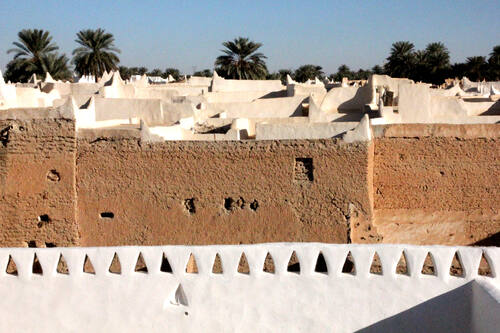
This is the amazing Old Ghadames, an oasis town in the heart of the Sahara desert is on the edge of Libya, close to both the Algerian and Tunisian borders. It was named an UNESCO World Heritage site in 1986.

Copyright: Federica Leone - UNESCO
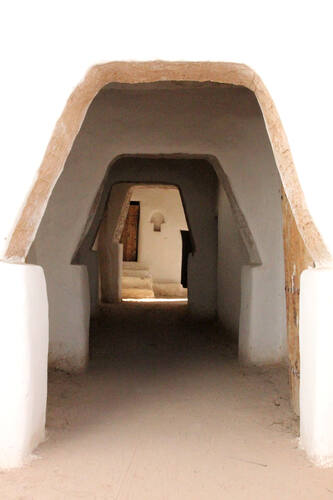
It is a whole abandoned city that's a labyrinth of interconnected rooftops and narrow dark tunnels, contrasting the brilliant white-washed walls which make the old town an architectural spectacle. The people of Ghadames are largely Amazigh Berbers and the old town of Ghadames has been inhabited since approximately 400 BCE. The Romans first mention the town, Cydamus, around 100 BCE. Ghadames was an important trade town until the late 1800s CE.

The last family voluntarily withdrew from the old town in the late 1990s, "due to a lack of water and electricity." I think more they were forced to move as that sounds like a suddenly odd reason now. The old town now stands as a monument to what was a feat of architectural engineering for a Saharan oasis town.

Traveller and cool chick Adela Suilman wrote about visiting Ghadames:


Local guide Mohammed tells me, "growing up in the old town as a child you quickly have to commit to memory the numerous tunnels and passages, determining which are true and which are dead ends. It stimulates a healthy memory!" 50 years on, Mohammed can still navigate the old town maze by heart as I blunder around behind him, barely able to see my hand in front of me. The stark contrast of dark and light, as well as the bright white buildings play tricks on the eyes and it's easy to become quickly bedazzled by this unique walled town. 
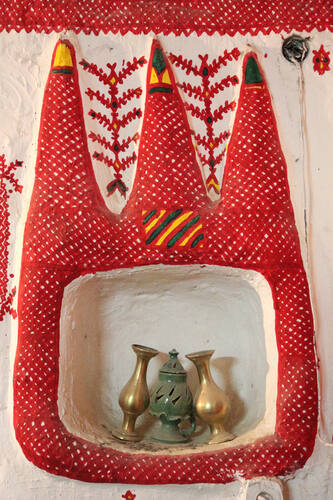
Moving into one of the traditional dwellings, one is immediately hit with a burst of colour which starkly contrasts the white outer walls. Traditional Ghadamesy colours are utilised, predominantly red with complimentary yellow, green and orange. Some front doors are also decorated with these colours to denote that its inhabitants have undertaken the Hajj pilgrimage to Mecca. 

Copyright: Federica Leone - UNESCO


Each of the rooms within the uniform 4 story houses has a designated purpose, whether it's wheat storage or rooms for washing the dead before burial. The high roofs and light colours make the houses intensely cool as a relief to the outside Saharan heat. As light is rare within the old town, mirrors are strategically hung on the walls throughout the houses to cleverly reflect light into each room. As one moves up the house to the rooftop you are greeted by a silent city. The roofs of all of the houses in the old town are connected by narrow walkways. Traditionally only women could roam the rooftops, acting as lookouts for Saharan caravans and news as well as being the primary location for them to socialise with one another.

So...too bad for me. It's too unstable and violent now for me to go safely into Libya and see this amazingly historically important and beautiful place. For now.

Monday, 9 November 2015

25 Years of Burma's Slog to Democracy


Hello all! After a brief respite and working on contracts, I'm back looking at the history in current events through my own slightly fractured abnormal lenses.


Because this is normal where I'm from.

This week in world events, something is happening I never thought I would see: Burma opposition leader Aung San Suu Kyi's party said Monday that it had won 56 of the 57 parliamentary seats from Burma's  main city of Rangoon, a result that portends a massive sweep in historic elections that could eventually give it the presidency next year.


CBC reports that "the National League for Democracy announced that it had won 44 of the 45 lower house seats and all 12 of the upper house seats from Rangoon, a party stronghold, in Sunday's general election. It also won 87 of the 90 seats in the Rangoon state legislature. Elections for regional parliaments were held simultaneously."


About 30 million people are eligible to vote for more than 90 parties that are contesting. The main fight is between the National League for Democracy, led by Nobel Peace laureate Aung, and the ruling Union Solidarity Development Party, made up largely of former junta members. A host of other parties from ethnic minorities, who form 40 percent of the country's 52 million people, are also running.


And why we should give two owls about this?

  Burma tour: a sleeping beauty awakes


We only care about the pretty countries under military rule.

As usual, history has screwed Burma so much, and these people deserve the chance to finally have the rights we do. In other words, freedom in all forms, including forking up their own country and not someone else always doing it to them. They may finally be freeing itself from the stranglehold of the military, which ruled the country for a half-century until 2011. 


Hang on to your hats: the primer on Burma's "Highlights of History" are here! Remember kids, everyone dies, horribly. So don't say I didn't warn you.


The double tap of Mongols and British Rule


Way back in 1057,King Anawrahta founds the first unified Myanmar state at Pagan and adopts Theravada Buddhism. But nothing was untouched by the Mongols anywhere: in the late 1280s they conquered Pagan and ran it till 1531, when the nation of Burma was formed. And like the Mongols, things get crazy when the British show up. From 1824-26 the First Anglo-Burmese war ends with the Treaty of Yandabo, according to which Burma ceded the Arakan coastal strip, between Chittagong and Cape Negrais, to British India. They took the rest in 1852 as Britain annexes lower Burma, including Rangoon, following the second Anglo-Burmese war. Burma becomes a province then a crown colony of Britain.

During WWII, the Japanese tried to copy the Mongols (that whole militarism thing) and Britain (the whole colonialism thing) and take Burma. The Burmese people rose up and were ‘liberated’ by the British. Aung San and six members of his interim government were assassinated by political opponents led by U Saw, a nationalist rival of Aung San's. U Nu, foreign minister in Ba Maw's government, which ruled Burma during the Japanese occupation, asked to head the AFPFL and the government. England now looks at the chaos of what they have partly been responsible for and as per usual, fork off. Burma gets independence in 1948.


And now the infighting starts….


In 1960 U Nu's party faction wins decisive victory in elections, but his promotion of Buddhism as the state religion and his tolerance of separatism angers the military. U Nu's faction ousted in military coup led by Gen Ne Win, who abolishes the federal system and inaugurates "the Burmese Way to Socialism" - nationalising the economy, forming a single-party state with the Socialist Programme Party as the sole political party, and banning independent newspapers. Many minority groups begin their fight against the government including the Shan, who up till very recently were still kick can all over the place.

Fast forward to the 1980s and the people are pissed. A currency devaluation wipes out many people's savings and triggers anti-government riots. Thousands of people are killed in anti-government riots. Martial Law is declared, arrests thousands of people, including advocates of democracy and human rights, and the country is renamed 'Myanmar'.

http://images.nationmaster.com/images/motw/middle_east_and_asia/burma_rel91.jpg

The cartographer's clearly gave up and just started using brackets.


Our heroine enters?


NLD leader Aung San Suu Kyi, the daughter of Aung San, is put under house arrest for her whole “I like democracy” button collection. After years of absolute bull-crap including multiple arrests, and no chance of seeing her dying British husband in the UK unless she concedes to these right wing nut jobs in uniform, Aung finally gets out in 2002. However, not all is rosy in the country as activists are continually arrested including Buddhist monks, who are not down with the whole “Do what I say or I’ll kill you deal” they keep getting.

Finally, it takes a fucking cyclone to get the government to move towards democracy. Cyclone Nargis hits in 2008. Some estimates put the death toll as high as 134,000. Referendum on new constitution proceeds amid humanitarian crisis following cyclone. Government says 92% voted in favour of draft constitution and insists it can cope with cyclone aftermath without foreign help. After a few more deaths – like 1000s – and more house arrests, the Banana Republic of Asia Called Myamar finally gets a break. In 2011, pro-democracy leader Aung says she will stand for election to parliament, as her party rejoins the political process. Myanmar abolishes pre-publication media censorship. The hard liners are either dead or removed from power. 

Aung San Suu Kyi Old

Pictured: Aung San Suu Kyi. She's just plain awesome.

Now What?

Current President Thein Sein dismisses rival Shwe Mann and allies from leading roles in ruling Union Solidarity and Development Party. Opposition leader Aung says ready to work with Shwe Mann, and she wins the most seats!

This does not mean things are going to be ok: these people lived through civil war, famine and death, a military run government with no freedoms, and they seriously have a country to re-build. But at least now they have hope. 

Aung San Suu Kyi. 


Thursday, 1 October 2015

The Rise of Cupcakes...with Frosting!

Warning: This article does not involve any vegetables.
I come from a long line of professional bakers: my father was a cook/baker in the military, his grandfather owned a bakery in Kingston, Ontario, his father before him...we have icing sugar in our veins. And one favorite of the family was cake. Cake was the king of all deserts in my house, even the raisin pie my dad made was humbled before his chocolate cake. It didn't hurt my mom was awesome at baking too.

Cupcakes however, were never in their repertoire. They are in mine though as I love these mini cups of heaven. Over the last five years, there's been an explosion of cupcake specific bakeries across Canada. Now the first flush of love is dying down, many of these places are now offering assorted cookies and other pastries as well. But the passion of the cupcake got me thinking...who was the first to develop cakes and cupcakes specifically?

Thank You Miss Simmons!


Cup Cakes (called Fairy Cakes in England) were first mentioned in American Cookery by Amelia Simmons in 1796, the first cookbook written by an American. She was probably a domestic cook in a family and was an orphan. Simmons probably knew about cupcakes from English bakers who made the lighter and smaller version of the cup cake. She writes:
A light Cake to bake in small cups:
Half a pound sugar, half a pound butter, rubbed into two pounds flour,
one glass wine, one do rose water, two do. emptins, a nutmeg, cinnamon
and currants.
Lovely Fairy cakes - note the absence of a tower of icing. But the designs are modern.


Another type of cup cake was the number cake, or 1234 cake, or quarter cakes as the baker could remember how much of what ingredient would go in.  One such Victorian era cup cake recipe that would have been a number cake:
CUP CAKES.

Two cups of sugar, one cup of butter, one cup of milk, three cups and
a half of flour and four eggs, half a teaspoonful of soda, large spoon
cream of tartar; stir butter and sugar together and add the beaten
yolks of the eggs, then the milk, then flavoring and the whites. Put
cream of tartar in flour and add last. Bake in buttered gem-pans, or
drop the batter, a teaspoonful at a time, in rows on flat buttered
tins.

To this recipe may be added a cup of English currants or chopped
raisins; and also another variety of cake may be made by adding a half
cup citron sliced and floured, a half cupful of chopped almonds and
lemon extract.

"Hey...let's get nuts and make tiny cakes? What do you think guys...guys?" - English Bakers in Victorian era.

The 20th Century Rises


Further refinement to cup cakes came int he 20th century. As you can tell from the two recipes from above, icing wasn't used. Cupcakes were finally decorated with frosting in the 1920’s and only with chocolate or vanilla. Taking a cue from modern baking methods, the first commercially produced cupcakes were launched around 1918, originally produced by the Taggart Bakery - then bought by Hostess. Early in the 20th century, the advent of multi-cupcake molded tins brought modest mass production methods to cupcake making, and a modern baking tradition was born! (Thanks University of Florida for the info). During the 1940’s cupcakes were available with Malted icing. Then it got even easier to make your own: Cake mixes, sold by Duncan Hines and others, made it easier and more popular to bake cakes and cupcakes at home.

The overwhelming popularity of cup cakes came about in early 2000s with the first cupcake only bakeries in America. Before this, cup cakes were made by general bakeries or at home. Magnolia Bakery in New York gained fame with their cupcakes from the huge hit show Sex and the City. One of the first cupcake only bakery was Sprinkles Cupcakes in 2002 in Beverly Hills.

Here's an amazing infograph just on cupcakes for you to enjoy before you head to the baking bowls to make your own.

history of cupcakes

Monday, 10 August 2015

Divine Rebellion: The History of Drag Queens

Harry S Franklyn, 1920s Drag Queen
(The scene: a hot summer day at my favourite beverage place, the Hop and Brew.)
Me: I'm writing an article on the history of Drag Queens.

Marc, my buddy from Seattle: Sounds cool. And I don't know anything about them. As a people or performers outside Priscilla, Hedwig...etc.

Me: I know some history but not outside of North America. My ignorance and your ignorance are perfectly matched.

Marc: (Laughs) That's the first I've hear that being dumb is good.

Me: Well, let's start off with your questions, then I'll use this as the base for the article.

Marc: Sure! And our reward for such an endeavor...more beer?

Me: Done!

What is a  Drag Queen? 


https://sp.yimg.com/ib/th?id=JN.VnkniSGNk7DgSiB2D4wanA&pid=15.1&P=0
Eltinge with and without his dress - 1920s

To get all technical on you all, a drag queen is usually a male of any ethnicity who dresses as a woman (in drag) with exaggerated femine traits for performance and entertainment in some capacity. Meriam-Webster dictionary online has the incorrect definition, that it's a homosexual man only. That's not the modern or current usage, as any performer can identify with any gender and sexual orientation. It does not mean the person also is a Transgender as well, which is when a person born with one gender transitions to the opposite gender, or none at all. But the line has always been blurry: the early 20th century American vaudeville and film performer Julian Eltinge is called the greatest female impersonator in theatrical history. His hyper-masculinity off the stage, and his very ambiguous sexuality is still up for debate.

Do they exist all over the world and for how long? 

Heck yes!  Men dressing as women in performance was very common in the European theatre world: you see it a lot in Shakespearean theatre even today. In Asia, Chinese and Japanese theatre, men would play the parts of women because women were not allowed on stage. I'll focus more on Chinese performers here, as gender in Chinese history was more my area of study in University. Men performing in drag were not the modern concept of drag queens: their actions cannot be divorced from the cultural context surrounding them. In an article by Dawei Ji,  he states that in 20th century literature they were viewed as undesirables:

... I name them "performers of the paternal past" where the word perform references both theatrical art and speech act theory. Often paired with paternal figures, they dramatize and visualize the past as if it were a theatrical play, but they also operate and sustain the past, as if it were a wristwatch that needed winding up. Furthermore, with their androgynous bodies, these ambiguously gendered characters represent trauma in China's history. Drawing on Julia Kristeva's explication of the abject in Powers of Horror, I argue that both female impersonators and the Chinese past exemplify abjection in these novels. The abject, like bodily excreta, is both filthy and indispensable for the subject. It lingers on the subject's borders, at once repudiated and retained. In the works that I discuss, the past is abjected by the present, and female impersonators, who seem to be detained in the past, are abjected by normatively gendered characters.
One of the modern performers is Li Yugang (李玉刚) who really blurs gender lines and sexuality normative with his videos and work in opera. On his facebook page it states "A charming woman on stage, a man in real life", because the whole thing could be a bit blurry...

She is all man...and can wear a dress better than me.

How about just in North America?


The term Drag Queen first appears in 1870s, and is a popular item on the vaudeville stages pre and post WWI. However, after WWII there was a big backlash against anything seen as counter-culture or not hetero-normative. Being a homosexual was never 100 percent legal, but now after 1945 in Canada, Mexico and the US the government and police actively persecuted all LGTBQ people. The wearing of opposite gender clothes were banned, and people were often publicly humiliated, harassed, fired from jobs, jailed or placed in mental institutions.

Rivera3.jpg
And then came Silvia...


The suppression could not continue: The growing gay rights movement in 1950s and 60s America really exploded in the 1969 Stonewall Riots, started at the legendary bar in New York. It was the only gay bar in New York at that time and was raided on June 28th, 1969. Many lesbians and drag queens began to fight back, including the drag queen Sylvia Rivera, who threw pennies and quarters at police. Three nights of riots ensued, where other drag queens like Marsha P. Johnson smashed a police car window with her hand bag. (You kick ass girl!)

Because of these early fighters, people began to embrace again the drag queens, and it came out of the closet as more performances and careers were launched. One famous drag queen who gained international fame was Logan Carter who rose to fame in the early 1970s. My personal favourite, Travis Shaw has been better known as Foxy De-Rossi, a biracial diva from Prince George who has been an great advocate for human rights.

Is it a derogatory term?


No it's not but it's up to the individual to what they would like to be refered to as. Drag queens in North America do not like the term Transvestite being used for them, as they are not Trans people. Others, however, have no problem with being called Tranny as they want to take back the term, just like the old slur "Fag" meaning gay man. It's up to the person: so ask! Or how about just calling them by their name, that works too.

OK - Divine and other extreme drag queens kind of freak me out...

divine-shake_it_up_s_1
She's fierce to me but I can't stand her music really....

...and that's ok, but understand that your reaction to another human being is important. Divine was Harris Glenn Milstead, (October 19, 1945 – March 7, 1988), an American actor, singer and Drag Queen best know for his work with filmmaker John Waters. He personally did not identify as Transgender, but male and gay, which flies in the face of many stereotypes of what a drag queen should be. He was, however, as Divine, very edgy and in your face. Who can forget his great comedic timing and slapstick act in Hairspray? So next time you're freaked out, understand not everyone has to like everyone's performances, but that Divine was just expressing herself and we should honour that.

Me: (After I give this to Mark) So beers next week? Are you buying?

Mark: Yep, and after all this, I might just throw in the pizza too.

Me: Thank you, Saint Divine...


For more info, ask a local drag troupe. Or do some reading and watching:

Around the World in 80 Drag Queens

I am Divine: A New Documentary

The Imperial Court

Thursday, 23 July 2015

Justice League! History of Nazi Hunters

Are there actual super heroes in the world? 


Yes. But they wear tights and live in Canada.

I think I may have found them: Nazi-hunters! Usually a private individual who tracks down and gathers information on alleged former Nazis who may have perpetrated the Holocaust in Europe during World War II, with the goal of bringing them to trial.

Recently they're in the news with the trial of Oskar Groening. This week he confessed and the German court ruled that he was guilty of being an accessory to the murder of 300,000 Jews and sentenced him to four years in prison:
The 94-year-old, who testified that he oversaw the collection of prisoners' belongings and ensured valuables and cash were separated to be sent to Berlin, listened expressionlessly to the verdict after a 2 1/2-month trial that could set a legal landmark. "This verdict was critical, because this is the first case brought where the prosecution charged a person who wasn't involved in the physical side of mass murder," said the Simon Wiesenthal Center's head Nazi hunter, Efraim Zuroff, in a telephone interview from Belgrade. "This paves the way for additional trials of individuals who did not literally pull the trigger but who were part of the implementation of the Final Solution."

It sounds so ultra-cool to be honest: who wouldn't love to hunt down evil doers? Are these guys real super-heroes?

The first Nazi Hunter:


simon wiesenthal Simon Wiesenthal, cazador de nazis austriacos famosos
Mr. Simon Wiesenthal. The sweetest looking man, ever.

One of the most well known hunters is Simon Wiesenthal was born on December 31, 1908, in Buczacz, in what is now the Lvov Oblast section of the Ukraine.  He attended the Technical University of Prague, from which he received his degree in architectural engineering in 1932. In 1936, Simon married Cyla Mueller and worked in an architectural office in Lvov. Their life together was happy until 1939 when shit went down: the purge of Jews by the Germans. As a result, by September 1942, most of his and his wife's relatives were dead; a total of eighty-nine members of both families perished.Wiesenthal himself survived after surviving a concentration camp - Mauthausen - which was liberated by an American armored unit on May 5, 1945. His wife as well had escaped. He didn't know she was alive but they reunited and had a daughter.

Wiesenthal began gathering and preparing evidence on Nazi atrocities for the War Crimes Section of the United States Army. After the war, he also worked for the Army's Office of Strategic Services and Counter-Intelligence Corps and headed the Jewish Central Committee of the United States Zone of Austria, a relief and welfare organization.

The evidence supplied by Wiesenthal was utilized in the American zone war crime trials. When his association with the United States Army ended in 1947, Wiesenthal and thirty volunteers opened the Jewish Historical Documentation Center in Linz, Austria, for the purpose of assembling evidence for future trials. But, as the Cold War between the United States and the Soviet Union intensified, both sides lost interest in prosecuting Germans, and Wiesenthal's volunteers, succumbing to frustration, drifted away to more ordinary pursuits. In 1954, the office in Linz was closed and its files were given to the Yad Vashem Archives in Israel, except for one - the dossier on Adolf Eichmann, the inconspicuous technocrat who, as chief of the Gestapo's Jewish Department, had supervised the implementation of the "Final Solution."

No - not that final solution...more like 6 Down: commit mass genocide.

While continuing his salaried relief and welfare work, including the running of an occupational training school for Hungarian and other Iron Curtain refugees, Wiesenthal never relaxed in his pursuit of the elusive Eichmann who had disappeared at the time of Germany's defeat in World War II. In 1953, Wiesenthal received information that Eichmann was in Argentina from people who had spoken to him there. He passed this information on to Israel through the Israeli embassy in Vienna and in 1954 also informed Nahum Goldmann, but the FBI had received information that Eichmann was in Damascus, Syria. It was not until 1959 that Israel was informed by Germany that Eichmann was in Buenos Aires living under the alias of Ricardo Klement. He was captured there by Israeli agents and brought to Israel for trial. Eichmann was found guilty of mass murder and executed on May 31, 1961.

Encouraged by the capture of Eichmann, Wiesenthal reopened the Jewish Documentation Center, this time in Vienna, and concentrated exclusively on the hunting of war criminals.He kept hunting Nazis till the end of his life. He died in 2005 at the age of 96.
 
Among Mr. Wiesenthal's many honors include decorations from the Austrian and French resistance movements, the Dutch Freedom Medal, the Luxembourg Freedom Medal, the United Nations League for the Help of Refugees Award, the U.S. Congressional Gold Medal presented to him by President Jimmy Carter in 1980, and the French Legion of Honor which he received in 1986. Wiesenthal was a consultant for the motion picture thriller, The Odessa File (Paramount, 1974). The Boys From Brazil (Twentieth Century Fox, 1978), a major motion picture based on Ira Levin's book of the same name, starring Sir Laurence Olivier as Herr Lieberman, a character styled after Wiesenthal.

The Boys from Brazil (1978)
And you know the evil guy by his mustache...

Wiesenthal's biographers credited him with ferreting out 1,100 of Adolf Hitler's major and minor killers and other Nazi war criminals since World War II. “When history looks back,” Wiesenthal said, “I want people to know the Nazis weren't able to kill millions of people and get away with it.”

One centre  is mentioned above, the Simon Wiesenthal Centre. Based in LA, they're a global human rights organization researching the Holocaust and hate in a historic and contemporary context. Not just a bunch of renegades, they are accredited as an NGO at international organizations including the United Nations.Their skills help uncover and locate where possible Nazis around the world are still in hiding. It's hard work:  first you got to find them; get enough evidence; and then persuade the authorities to act. They are still at it even though so many are so old and well, dead.
What a nice thought that eventually those bastards are worm food too.

An odd personal connection for me: a friend from university does historical research on Belarus and Ukraine and he had a lot to do with one war criminal hiding in Canada - Vladimir Katruuk served as a platoon commander of the first company of Ukrainian Schutzmannschaft Battalion 118 which carried out the murder of Jews and innocent civilians in various places in Belarus. He escaped to Canada after World War II but was stripped of his Canadian citizenship in January 1999, after his service as a Nazi collaborator was revealed. In May 2007, the Canadian authorities decided to overturn his denaturalization, a decision confirmed by the Federal Court of Appeal in November 2010. New research by Swedish historian Dr. Per Anders Rudling revealed Katriuk’s active role in the mass murder of the residents of the village of Khatyn, Belarus and provides a firm basis to overturn the decision not to strip Katriuk of his Canadian citizenship. 

Nice job sir. To read more on his research, go read this.

Next week's article is a little lighter: when did we start keeping pets?

... -pets/][img]http://www.imgion.com/images/01/Cute-Pets.jpg[/img][/url
After all that Nazi talk, I needed a cuddle.