Showing posts with label Canada. Show all posts

Wednesday, 18 May 2016

A Very Late Apology: The Komagata Maru, Canada and Racisim


Today, something happened. Canada said sorry...again. For another bad screw up. This one has been 102 years in the making.
As reported by the CBC:
Nearly 102 years after the Komagata Maru sailed into Vancouver, Prime Minister Justin Trudeau has offered a full apology in the House of Commons for the government of the day's decision to turn away the ship, which was carrying hundreds of South Asian immigrants, most of whom were Sikhs.
The Komagata Maru arrived on Canada's West Coast on May 23, 1914, anchoring in Vancouver's Coal Harbour. Nearly all of the 376 passengers were denied entry and the ship sat in the harbour for two months. It was ultimately forced to return to India and was met by British soldiers. Twenty passengers were killed and others jailed following an ensuing riot.
The Maru was a Japanese steamship chartered by wealthy Sikh businessman, Gurdit Singh, who was then living in Hong Kong. Its passage was a direct challenge to Canada's immigration rules, which had grown increasingly strict — and discriminatory — at the turn of the century. 
Canada needed immigrants to cultivate western farmland but preferred those from the U.S, Britain or northern Europe. 
India had been a British colony for almost 200 years at this point, and Singh believed British citizens should be able to freely visit any country in the Commonwealth.
Komagata Maru passengers
Passengers from the Komagata Maru, shown in 1914. (James L. Quiney/City of Vancouver Archives) Too bad if you think you're all equal to us superior white people...oh...you did...this is awkward...
The steamship departed Hong Kong on April 4, 1914, making stops in Shanghai and Japan. Previously used to transport coal, the Komagata Maru had been transformed for the long journey.
Word of the ship's intended destination quickly reached Vancouver, where anti-Asian sentiment was already in full swing. Local newspaper headlines of the day decried its arrival as a "Hindu invasion."  Yeah - like Hindus and Sikhs are the same...
In Vancouver, the Komagata Maru was immediately greeted by immigration officials who refused to let its passengers disembark. Twenty people determined to be returning residents were eventually permitted entry, but no one else stepped foot off the boat.  
For two months they sat there. Eventually, they gave up and headed back home to Calcutta. Where they were promptly arrested, and 20 people were killed. Thanks Canada.
li-komagatamaru-620

Party Boat? The Komagata Maru sits in Vancouver's Coal Harbour in 1914. The ship became a spectacle for locals during its two-month stay at the waterfront. 
The Prof. Mohan Singh Memorial Foundation, founded in 1990, has been lobbying for an apology for nearly 25 years, working with local, provincial and federal politicians.
Finally, after everyone is dead, Canada gets around to apologizing. While I am glad of it, and for my Sikh friends, it's a typical move by our country to apologize for being shits to certain groups of people long after the fact. I have an idea: maybe we should stop being racist shits. Maybe?

Monday, 4 April 2016

New Viking Settlement In Canada Located- Pointy helmets not found yet

The internet is exploding with news of a new Viking site in Canada.

Otherwise, it's all about an epic text conversation over boyfriend buying makeup for his girl. ZZZZZZZ


Archaeologists have used satellite imagery to identify a site in Newfoundland that could be the first new Viking site discovered in North America in over 50 years.

Satellite imagery, magnetometer surveys, and a preliminary excavation of the site at Point Rosee in Southern Newfoundland last year could point to a potentially fascinating discovery.

Until now, Newfoundland has the only Viking site in North America, found in the 1960s at L’Anse Aux Meadows on the northern tip of Newfoundland, about 300 miles from Point Rosee.

Discovery News online reports that the new site was identified by Archaeologist Sarah Parcak of the University of Alabama, Birmingham, used high-resolution satellite imagery to spot ruins as small as 11 inches buried below the surface:

From Discovery. To the trained eye it still looks like..a mossy bog.

The archaeologists’ investigation will feature in “Vikings Unearthed,” a special of PBS’s NOVA science series, co-produced with the BBC, that premieres online on April 4. The special will air on PBS April 6.
Satellites positioned around 478 miles above the Earth enabled Parcak and her team to scan a vast section of America and Canada’s eastern seaboard.
The satellite images, two magnetometer surveys, and preliminary excavations suggest “sub-surface rectilinear features,” according to the experts, who also identified possible evidence of ironworking in the form of roasted iron ore. Radiocarbon technology has dated the site to between 800 and 1300 AD. 
The project was led by Parcak and co-directed by Gregory Mumford, an associate professor at the University of Alabama at Birmingham and Frederick Schwarz, of Black Spruce Heritage Services. Douglas Bolender, an archaeologist at the University of Massachusetts, Boston, and historian Dan Snow also participated in the investigation.
Less in the middle of Nowhere, Newfoundland than the other one as the ferry dumps you off in Port-au-Basque.


We all know that the vikings brought the fun in New-Fund-land...ok bad attempt at pun. But the fact that if this data is confirmed as Norse by further research, the site will show that the Vikings travelled much farther in North America than previously known, pushing the boundary of their explorations over 300 miles to the southwest.

And another tourist site for Newfoundland to promote the hell out of.


Sunday, 22 November 2015

She Shoots and She Scores! The History of Women's Soccer

1907 Oahu College women’s soccer team (photo courtesy Futbol Heritage Archive).

I love watching Women's Football (Soccer) especially cheering for the Women's National Team! They are getting ready for the Olympics in Rio. The team won a bronze in 2012 and I'm hoping for even better next time as the coach is very good:

"Canadian women's soccer coach John Herdman has summoned the heart of his World Cup team along with an injection of youth for his first camp on the road to Rio. Herdman's roster includes captain Christine Sinclair and fellow World Cup veterans Erin McLeod, Rhian Wilkinson, Allysha Chapman, Diana Matheson, Sophie Schmidt and Melissa Tancredi..."It's an exciting group we've brought together." Herdman said Sunday from Vancouver. "I really do hope we can find some of the quality that we are going to need to get on the Olympic (podium)."
It's been a real hard slog for the ladies in soccer though. Their history is marked by extreme prejudice and male-domination over their actions. Despite that, the ladies love the sport and have stayed strong over the 100 plus years of playing.
In the early 20th century, women were playing the game seriously in different parts of  the US, Great Britain, France and Canada. The picture above is a college competitive team picture from Hawaii. (Educated and playing soccer? Wow they must have pissed a lot of old white dudes off) Some facts point that in Central Europe, competitive soccer was not uncommon. Such games were often played without compliance with the civil and church authorities.


One of the popular records of the game comes from Boxing Day in 1920, at Goodison Park in Liverpool. A spectacular game took place on England’s biggest soccer ground where Dick, Kerr Ladies played with a Lancashire team called St. Helen Ladies in front of a crowd of 53,000 people. It is noted that more than ten thousand fans had to be locked out when the ground became fully occupied.


Picture
The winning team - sexism not in picture.
However, the men in power did not like it.
The crowd size on that day was seen as a major threat at the headquarters of Football Association in London. Also many men complained that it was "distasteful" for women to play. In 1921, the influential central body of the game set a ban on women for playing soccer for an incredible period of 50 years. The repercussions could be seen immediately as this decision crippled women soccer players in a few countries. However, Italy and France established women’s leagues in early 1930s. Women continued to play soccer despite the bans across the world as amatures. The Dick, Kerr Ladies FC continued to play.
After the war, the graph took an upward turn with Italy establishing its national association in 1950 and Germany organizing the first informal women European championship in 1957. Northern European countries were also part of the development, especially Norway and Sweden. Even though most countries had women’s teams, it wasn’t until 1971 that the ban was lifted in England and women could play on the same fields as the men.

A year after the ban was lifted, women’s soccer in America became more popular due to Title IX. Title IX required that equal funding was given to men’s and women’s sports in colleges. The new law meant that more women could go to college with a sports scholarship, and as a result, it meant that women’s soccer was becoming a more common sport at colleges all over the United States.Surprisingly, it wasn’t until the 1996 Olympics in Atlanta that women’s soccer was an Olympic event. At that Olympic Games there were only 40 events for women and double the amount of men participants as there were women.

One massive step forward for women’s soccer was the first Women’s World Cup, which is a soccer tournament that has teams from all over the world play each other. This first tournament was held in China on November 16-30, 1991. Dr. Hao Joao Havelange, the president of the Fédération Internationale de Football Association (FIFA) during that time, was the person that initiated the first Women’s World Cup, and because of that first World Cup, the United States created a name for itself in women’s soccer.

The original Canadian Women's National Team wore second-hand boys' jerseys
The original 1986 Canadian Women's National Team wore second-hand boys' jerseys (Canadian Soccer Association)

Overall, the 1960s, 1970s and 1980s were years of enormous success for Canadian women in sports. The 1960s and 1970s witnessed the emergence of the “women’s liberation” movement in North America. Women increasingly fought restrictions in all areas of life, including sports. Plaintiffs brought sex-discrimination cases to court, arguing that girls should be allowed to play in games, and on teams, that were traditionally reserved for boys. In 1981, feminist athletes and activists established the Canadian 
Association for the Advancement of Women and Sport (CAAWS). 

 It was Canada Day, July 1, 1986, when the Canadian Soccer Association brought together 20 players to make up the first women's national team. The squad had three days in Winnipeg to get to know each other and sort out strategy before embarking on a day-long bus ride to Blaine, Minn., to face the U.S. in their first game.

But sexism reigns still in soccer and in women's sports. Despite the success of women in all types of sport, female athletes are still judged to some degree on their physical attractiveness. Another challenge facing female (and male) athletes is that of homophobia, which continues to persist in the world of sports. There has long been paranoia about homosexuality in women’s sports, and many female athletes and teams have taken pains to emphasize their heterosexuality and femininity in response to societal fears about masculine women athletes. Few gay athletes have felt comfortable revealing their sexuality while in active competition. However, in September 2013 Olympic speed skater Anastasia Bucsis stated publicly to the Globe and Mail that she was “proud to be gay”; her statement may be a sign that the Canadian sporting world is becoming more inclusive.

Thursday, 28 May 2015

History Now: International History News (Includes Canada)

It's been a busy spring for me personally but also professionally. While I've been working like a dog, (a small pug I think), let's see what's been making the news the last few months in local and world history.

First, a tip of the pink stetson to Calgary! 


It's the 25th anniversary of the Calgary Pride Festival. The festival and the events surrounding it (including the parade) is run by Calgary Pride. The CPF is a not-for-profit organization that exists to promote equality and acceptance of Calgary’s LGBTQA community. My friend Kevin Allen wrote in the Gay History Project blog that Calgary’s first “Pride Week” started as a weekend of workshops in 1988.  In 1990, Calgary’s 3rd Annual “Pride Festival” had a political rally that drew 400 at Memorial Park, on the steps of the library. The first real parade was in 1991, and was actually part of the 4th Annual Pride Festival. This year's parade will be September 6 down 9 Avenue SE to SW downtown.

CLAGPAG Today 2
We thank you: Stephen Lock, Nancy Miller & Richard Gregory: 1990 Pride Rally Organizers. From Gay History.


Why do I know so much about Queer (Gay) history in my hometown? I'm one of the researchers for the Gay History Project and will be presenting at the Glitter Gala next month. Come have fun and hear me make history interesting!

I'm On the Road to Stonehenge


Next, I want you to take some deep breaths before you read this next news story.

 The brilliant people who are road planners in the UK are hoping to get a traffic tunnel dug under Stonehenge. In 2013, a major roadway near the giant rock circle was partly closed, because it was damaging the site. However, traffic has been insane as there is a major road corridor near the site. The answer: build a tunnel: The BBC Reports:

Deputy Prime Minister Nick Clegg said the plan to "tackle the bottleneck at Stonehenge" would "get the funds it needs". English Heritage, which runs the Stonehenge site, has previously described the bottleneck road as "highly detrimental" to the ancient monument. Senior Druid King Arthur Pendragon has also backed the idea of a tunnel, but only if there are "cast-iron" guarantees that any human remains found "are reinterred as close as possible to what should have been their final resting place".

A group that advises World Heritage body Unesco has warned a tunnel could have an "adverse impact" on the Stonehenge landscape. In a letter seen by the BBC, the International Council on Monuments and Sites (Icomos) said it wanted a solution that "respects and maintains" the value of the "iconic and unique site". Ralph Smyth of the Campaign to Protect Rural England (CPRE) said it was "calling for a longer tunnel", as the proposed tunnel was too short and would create two "huge holes" which would affect the landscape around the World Heritage site.
OOOOOH....now where's the MacDonald's?

Screw You Labour History


Let's head back to Canada for the next bit with some serious controversy. The Museum of History in Ottawa has announced that they are excluding a display on the 1919 Winnipeg General Strike will be excluded from the renovated areas, but officials promise the labour movement will still have a home in its halls.

According to a document obtained by the Ottawa Star in response to an access to information request, the Canadian Museum of History in Gatineau, Que., saw there were few risks (???) surrounding the decision to shut down the exhibit.

Here is the part that pisses me off...

“Changes can be made to the module with few political or institutional risks,” reads the summary of a draft renovation risk assessment, revised Aug. 22, 2014. "Some comments by academics cite the closure as evidence of the museum’s lack of interest in working class history . . . . The removal of this module represents minimal risk to the museum, though it will entail communications challenges to the academic community,” says the document.

OK - WAIT A MINUTE. So academics are the only people interested in working class/labour issues? Classes of school kids that have it in their curriculum to learn about the history of the strike and other labour issues are dismissed as "academics"? Thank you for your condescending air. Sorry that as a working class person you want to know more about our history, or recall how mostly soldiers were the ones striking as they were promised things the govt. and businesses never delivered for dying on the fields in WWI.

Canadian Museum of History
Go fuck yourself History Museum. Never thought I'd say that.
The exhibit, which opened in 1999, was modelled after a meeting room in the Labour Temple on James St. in Winnipeg, where union members met to debate, organize and vote in the months leading up to, and during, the massive strike. It's being removed to make room for the Canadian History Hall, which is scheduled to open July 1, 2017. I'll be dammed if I go.

Because 30,000 people is just not that important. Sorry guys.

The Canadian Museum of History has come under public scrutiny in the past couple of years, following a controversial change in name — it was formerly known as the Canadian Museum of Civilization — and mandate that had critics accusing the Conservative government of using the Crown Corporation to rewrite history in its image.

Chinese Tomb Reveals Awesome Bling


Lastly, something less depressing and way more flashy. After workers discovered the brick tomb by chance at a construction site in Nanjing, China, archaeologists from Nanjing Museum and the Jiangning District Museum of Nanjing City excavated it back in 2008. Their findings, originally published in Chinese in the journal Wenwu, have recently been translated into English and published in a recent issue of the journal Chinese Cultural Relics. (Reported by History TV)

The archaeologists found that water had damaged the tomb, but the occupant’s skeletal remains remained inside. In addition, the tomb’s interior sparkled with gold baubles, including hairpins, bracelets and a small fragrance box. All are intricately engraved in designs of lotus petals, chrysanthemums and flames, and all are inlaid with precious gems, including rubies, sapphires and turquoise.

Credit: Chinese Cultural Relics
BLING!
 
The owner of the tomb had a beautifully adorned but challenging life. Her story really tells a lot about women in Traditional China, their lives and their deaths.
Two stone inscriptions, or epitaphs, found inside the tomb identify its occupant as one Lady Mei, and tell the story of her life in Ming Dynasty China more than five centuries ago. Born around 1430, she was probably a teenager when she married the decades-older Mu Bin, a duke of Qian who ruled Yunnan province in southwestern China. A former concubine, she would probably have been lower in status than Mu Bin’s two other wives.

Ten months after she gave birth to a son, Mu Zong, her husband died. According to her epitaphs, Lady Mei was then only 21 years old, “unwashed and unkempt, and called herself the survivor.” She dedicated herself to the care of her infant son, and began carefully grooming him to become a third-generation duke. Among other things, she “urged him to study hard mornings and evenings, and taught him loyalty and filial devotion, as well as services of duty.”

When it was time for Mu Zong to take the reins in Yunnan, Lady Mei traveled with him to meet the Chinese emperor, who was impressed by Lady Mei and later awarded her the title “Dowager Duchess.” Her son gave her much respect, and turned to her for advice on being a judicious leader and a faithful representative of the emperor. Specifically, as the epitaphs relate, she provided Mu Zong with “strategies for bringing peace to the barbarian tribes and pacifying faraway lands.”
Lady Mei was only in her mid-40s when she died of illness in 1474. She was brought to Nanjing for burial; the city served as the capital of China during the early Ming Dynasty. The emperor himself apparently ordered officials to prepare for Lady Mei’s funeral and burial. Meanwhile, the epitaphs describe widespread mourning for the Dowager Duchess back in her son’s province: “On the day of her death, the people of Yunnan, military servicemen or civilians, old and young, all mourned and grieved for her as if their own parents had passed.

Monday, 20 April 2015

Digging in the Dirt: Canadian WWI Soliders Grave located in France

The Battle of Vimy Ridge.jpg
Richard Jack's painting of the Canadian's at Vimy Ridge, Library and Archives Canada. No zombies were present.

We often think that World War One is in the far off land of the past: a place we read about but has no affect on our daily life. Well, we're wrong. Not only does the outcomes of the war still affect us today, as my rant about Israel and Palestine covers, but the men who died still keep popping up. No: I don't mean some tacky war-splotation (my new word) zombie film like Dead Snow where the Nazis live again. Because nothing makes my skin crawl more than real suffering being reduced to zombie SS eating Sweeds.

Deathwatch (2002) Poster
Oh...some tacky bastards did make at WWI horror film...with Jamie Bell. So disappointed in you Mr. Bell.

Norm Christie, an Ottawa historical researcher, has located the remains of possibly 44 members of the Canadian Scottish Regiment (16th Battalion, 3rd Brigade, 1st Canadian Division) who were buried in a shell crater following the Battle of Vimy Ridge in April 1917. Their deaths were registered, but their remains were never exhumed and reburied in any of the military cemeteries established after the First World War.

The Canadian Encyclopedia states that:
The Battle of Vimy Ridge, during the First World War, is Canada's most celebrated military victory — a sometimes mythologized symbol of the birth of Canadian national pride and awareness. The four divisions of the Canadian Corps (see Canadian Expeditionary Force), fighting together for the first time, attacked the ridge from 9-12 April, 1917 and succeeded in capturing it from the German army. More than 10,500 Canadians were killed and wounded in the assault. Today an iconic white memorial atop the ridge commemorates the battle and honours the 11,285 Canadians killed in France throughout the war who have no known graves.
In an interview last month with the National Post, Christie states that it is time to exhume these men and place them in properly marked graves.“One of the key aspects of history is the spiritual dimension. How you treat your dead is very reflective of the spiritual state of your society. We should be honouring our dead because they are so much a part of our history.”

That spiritual aspect is physically represented by the amazingly beautiful Vimy Ridge Memorial. Work began on the monument in 1925 and eleven years later, on July 26, 1936 it was unveiled by King Edward VIII. It cost approximately $1.5 million, including site preparation and the building of roads.

Wow.

Finding this possible grave site also brings up the issue of ongoing duty to these men: the call for the re-burial of these men, and the continual search for others lost in both world wars, is expensive, but necessary in many people's opinion. The Government of Canada is always under pressure to fund these initiatives, but mostly rely on the Commonwealth Graves Commission, which Canada is a member of.

The other issue is of glorifying way: modern opinions may not be to many modern people's taste of military history. Christie cites the attitude of dismissing our military history in the 1950s onwards as deplorable. “History is the heart and soul of your society. That is where you get your pride from, your sense of identity, and because Canadians lack a sense of their history, they lack a certain pride.” Christie has certainly done what he can to instill historical pride. Over the last two decades, the former Commonwealth War Graves Commission’s chief records officer has written nearly 20 books on Canada’s military history.

For my two cents: I'm biased as hell. Two great-grandfathers fought in the war, my father and brother are ex-Canadian military. The idea of them not being honoured or buried properly would bother me forever. These were men whose families loved them and despite the dangers, did their lives to a cause they believed in, whether you agree or not with that cause.

And as we all know, war is horrific and as a hard core pacifist, I don't want Canada ever involved in anything like this again. But we were, and I don't think honouring the dead is promoting any idea of how we should be conducting our military now. This was suppose to be the War that Ended All Wars because it was such a horrific loss. So while we re-bury the dead, let's recall how they got there in the first place and maybe we won't be so quick to send people to their deaths again.

Monday, 24 November 2014

The Imperialist: Grey and the Canadian Football League

This weekend my home town team won a spot in the Grey Cup - Go Stamps!
Bronks_101008.jpg
The Stampeders originally were the Bronks, glad they changed the name. Sounds like a horse snorting.

I type this as a sad and dejected Eskimo fan with a toque on sits down across from me in the coffee shop. Next time guys!

It will be the 102st Grey Cup, the Canadian Football League's Superbowl, filled with history and pageantry in Vancouver. I really didn't pay much attention to the history of the game in Canada until the game's centennial in 2010. And while I learned a lot, I noticed the media had only a few words on the imperialist father of the Grey Cup, Albert Grey.

Whose this Grey guy anyways?
Lord Albert Grey, wearing fur because he is in Canada. Picture:LAC

Lord Albert Grey was your quintessential Victorian imperialist elite gentleman. Like most of the elite class in Canada. he was born in England in 1851 to rich parents and had a career in politics. His tireless promotion of the Crown and the supremacy of imperialism underlined every action he ever took. He remained in England until the call of money and power came from Africa, where he became an administrator in Rhodesia (Zimbabwe). Rhodesia was controlled by the British South African Company, and therefore controlled the people and the land. However, the government called Grey back to serve as Governor General (the King's representative) to Canada in 1904. He also needed a job as his investments in the region failed.

At this time, Canada was trying to forge itself as an independent nation, but also keep their British overloads happy. Canada was a dominion, meaning we still had to look to mother Britain for the okay to all our laws. This was alright to Grey, who liked to impose his ideas on others, be it in South Africa or in Canada. Funny enough his hard core temperance ideas and pro church stance did not go down well in Canada. He had to be reigned in a lot by Prime Minster Laurier, because even back then Canadians really just liked life without too much interruption. His idea that Canada should be the crowning jewel in British imperialism meant he pushed hard for a navy and a larger military as a tool for expansionism.

Grey's ability to cock up diplomatically was of epic legend. One failure was trying to get Newfoundland into confederation with Canada in 1905: he acted more like a bully than a appeaser and so the newfies told him to bugger off. The biggest failure was the Plains of Abraham in 1908: he wanted to purchase the Plains of Abraham and turn them into a national park under a battlefield commission for Quebec's 300 year birthday.

His endeavours to elevate the project into a grand imperial enterprise fell short but nevertheless made it difficult to sell in Quebec. In the end Laurier was persuaded only by the intervention of Quebec mayor Georges Garneau to pass the potentially controversial legislation in March 1908 creating the National Battlefields Commission. During this campaign Grey had discovered a citizens’ committee making modest plans to mark the tercentenary of Samuel de Champlain’s founding of Quebec. Fresh from his battlefield victory, he decided to transform the event into an international celebration of Franco-Anglo-American friendship. The visit of the Prince of Wales, the Atlantic fleet, American and French warships, and a host of official representatives required coordination, diplomatically, by the governor general’s office and took arrangements well out of the hands of the local committee. In addition, the elaborate historical pageants promoted by Grey and staged in July threatened, despite their interpretative accommodations, to turn the event into a celebration of the arrival of British general James Wolfe in 1759 rather than Champlain. The criticism voiced  was understandable, but not to Grey, who blamed the reaction on an unenlightened element in the Catholic church.
One thing that he was successful at was smoothing over the rough waters between Canada and American after the latter purchased Alaska from the Russians. He also promoted, supported and loved sports and the arts, assisting a ton of organizations in Ontario and Quebec during his tenure.

Why did he like football so much?


Grey believed that cultural institutions were an excellent vehicle to promote imperialism. One of these paths was through sports.His interest in physical well-being came from his work in social reform and imperial wholesomeness, as well as from his own attachment to sport and the outdoors. He promoted overseas clubs backed the Boy Scout and cadet movements, and persuaded Lord Strathcona to amend the terms of his trust fund (set up in 1909 to promote physical and military training in Canadian public schools) to permit the remuneration of women cadet instructors.

He donated various cups to all sorts of sports, but the biggest was to the new amateur rugby football league in 1909. Originally he wanted to donate a cup to the newly formed Canadian hockey club but was beaten to it by Sir Allen.

The first winners of the Grey Cup was the University of Toronto who trounced Toronto Parkdale 26-6.


But Grey soon forgot about his promise. There was no trophy to present when the University of Toronto won but they did receive it in time for their photo. Weeks before the game, organizers sent a letter to the governor general reminding him of his promise, according to the Canadian Football Hall of Fame and Museum. A hurried order was sent to silversmiths to create the sterling silver cup with a wooden base. The total bill: $48.

Having researched so much on Albert Grey now, I wonder what he'd think of modern Canada, our looking more to America for our policies, and our attitudes towards our colonial past that gives us so much shame and trouble now? More importantly, what would he think of our CFL now, with multi-ethnic players and owners, and a lack of imperialistic fevour?

Thursday, 6 November 2014

Going Home: World War I Solidiers Identified

First off, much thanks to you all for reading my little blog. I finally have about ten of you reading it on a daily basis, and that's really nice. I just love history so I'm glad to share some of this love with you.

Now, enough of the mushy stuff...oh actually there is more. Get your Kleenex out.

Sidney Halliday
Sidney Halliday

Good news from the field of muck. No, not the much-embattled CBC, but their report on the identification of soldiers from WWI from the mud of France. The remains of a unknown soldier have now been identified as Canadian Pte. Sidney Halliday. The Department of National Defence (DND)announced today that they had identified Halliday's remains. His remains was one of eight discovered together in France in 2006. DND revealed the identities of four others September 27.

The feel good part is how he was identified.  His sweetheart Lizzie gave him a locket with her hair. He carried that all though the war and it remained on his body when he was killed by a bullet to the head in 1918. When they found the locket, they could see her name etched on it.  Thanks to meticulously written war records, Sidney's records indicate that he had left most of his meagre wealth to his mother but at some point had asked for a change to be made. He asked that $10 go to Lizzie Walmsley of Winnipeg. The researches put all of it together and realized that these were the remains of Sidney.

How'd he get there?


Tim Cook write in Shock Troops: Canadians Fighting The Great War 1917-1918 about the Battle of Amiens, where Haillday died. It began before dawn on Aug. 8, 1918.That offensive included four Canadian divisions and the Canadian Cavalry Brigade. Canadian troops would be the spearhead of the attack.There were 300,000 Allied troops in total, a third of them Canadian. The Allies also had "the largest tank force ever assembled to that point in history," he writes. Cook also says that on Aug. 11, near the eastern edge of the battle, infantrymen in Canada's 78th Battalion found themselves surrounded as they tried to hold on to the village of Hallu. 100 men were killed or went missing that day. These men were unknown and were buried there where they fell. 
Hallu, France today. Yeah war has a funny way of destroying everything

How did they do this after he and his fellow soldiers were in the dirt for 96 years?


First thing is someone has to find them. France is littered with the bits and bones of the dead from two world wars. A teenager in this case, Fabien Demeusere, was poking around in his backyard which use to be the town of  Hallu for military belts and other items. Surprise: He found their bodies instead. I imagine he pooped his pants at finding some dead guy's skull in his yard.


He did the right thing and called the police and government, They realized these were probably Canadians and called the Department of National Defence. The task of identifying the remains fell to Casualty Identification Coordinator, Laurel Clegg. Using official war records that contained ages and heights of the missing, Laurel was able to narrow down the possibilities. Genealogist Janet Roy helped find descendants of the missing men from the 78th. DNA was used to positively identify five of the eight: Lieutenant Clifford Neelands and Privates Lachlan McKinnon, William Simms, Sgt. John Lindell, and now Halliday.

 For more on the men of his regiment, I suggest the documentary Forgotten No More, The Lost Men of the 78th, which will be broadcast on CBC on November 7th.

Why you should give a toss?


I always like to give a reason why you should give a shit about a 96 year old dead guy. For one, the amazing work of the team at DND should be recognized and celebrated. No way was this easy to do as they crawled through documents and details for the last six years.

Also he's just not a name - Halliday was a human being who died from a gun shot to the head in a stupid war. He had dreams, friends, a girlfriend, family who missed him and never got to bury a body. His surviving nephew Jim Halliday said to the CBC:
"I guess it makes you feel as if he just passed away, instead of all those many years ago...it's a strange feeling. It's one you can't really explain all that well, brought some sense of closure, as they say."
And maybe when we honour all our dead, we find maybe we think long and hard if we want to add to the list of our war dead with our modern wars and military actions.


Saturday, 14 June 2014

Monday, 26 May 2014

Uncomfortable History: Racism and the Komagata Maru Incident


In Canada, we often like to slap our own backs a lot about how multicultural we are, how accepting we are of other peoples. Heck, since 1971 when our government declared multiculturalism a state goal, we've been saying how awesome we are.

Let's not forget our racist, imperialist past. 

Officials board the Maru 1914 - Vancouver Public Library
A hundred years ago this week, Canadians denied a ship load of immigrants because they were not white and they might be supporters of independence in Indian.

On May 23, 1914, The Komagata Maru from Hong Kong carrying 376 passengers, most being immigrants from Punjab, British India, arrived in Vancouver's Burrard Inlet. They wanted to challenge the Continuous Passage regulation, which stated that immigrants must "come from the country of their birth, or citizenship, by a continuous journey and on through tickets purchased before leaving the country of their birth, or citizenship." The regulation had been brought into force in 1908 in an effort to curb Indian immigration to Canada.

Why no Indians in Canada? To quote the 1923 Immigration Act, the desirable immigrants were in these two categories:

a) "Preferred Category": British and Americans, West Europeans. Example: the Empire Settlement Scheme, 1923.
b) "Acceptable Category" (although not "preferred"). immigrants in "sheep-skin coats". East Europeans (Russians, Ukrainians, Poles); South Europeans (Italians, Greeks, Spaniards). If they go West and farm, they will be accepted although considered "foreign", as long as they know "their place".

As a result, the Komagata Maru was denied docking by the authorities and only twenty returning residents, and the ship's doctor and his family were eventually granted admission to Canada. The ship was then escorted out of the harbour by the Canadian military on July 23, 1914 and forced to sail back to Budge-Budge, India where nineteen of the passengers were killed by gunfire upon disembarking and many others imprisoned.

What is rarely focused on in the may sources is the human drama unfolding and why would they even try to come to Canada, knowing they might be turned away. What makes people so desperate?

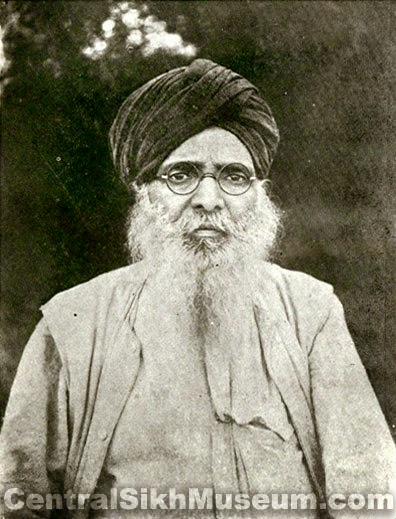
Baba Gurdit Singh - a nice man who clearly had enough
These were British subjects, but many were under the scrutiny of the British government. At the time in India, the call had gone out for independence. Some men on the boat were members of the Ghada Party. They conducted revolutionary activities in central Punjab and attempted to organize uprisings against the British overloads.

One member was Gurdit Singh. In 1911 he raised his voice against forced labour. He wrote to the Government complaining against officials who forced poor villagers to work for them without remuneration, and when he received no response, he exhorted the people of his village to refuse to be subjected to forced labour.

He's the one that chartered a Japanese ship, Kamagata Maru in 1914 to go to Canada.The obstructions put up by the alien authorities and the hardships faced by its passengers turned them into staunch nationalists.When it was turned back and reached Calcutta, the passengers were not allowed to enter Calcutta, they were rather ordered to board a Punjab-bound train especially arranged for the purpose. They refused to do and many of the passengers were shot dead. Gurdit Singh escaped and remained underground for many years till in 1920 on the advice of Mahatma Gandhi he made a voluntary surrender and was imprisoned for five years. After his release he settled down at Calcutta where he died in 1954.
Why did he do what he did? One quote sort of lets us know:

Memorial in Punjab to the people and to Singh
“The visions of men are widened by travel and contacts with citizens of a free country will infuse a spirit of independence and foster yearnings for freedom in the minds of the emasculated subjects of alien rule.”
~ Gurdit Singh