Showing posts with label Komagata Maru. Show all posts

Wednesday, 18 May 2016

A Very Late Apology: The Komagata Maru, Canada and Racisim


Today, something happened. Canada said sorry...again. For another bad screw up. This one has been 102 years in the making.
As reported by the CBC:
Nearly 102 years after the Komagata Maru sailed into Vancouver, Prime Minister Justin Trudeau has offered a full apology in the House of Commons for the government of the day's decision to turn away the ship, which was carrying hundreds of South Asian immigrants, most of whom were Sikhs.
The Komagata Maru arrived on Canada's West Coast on May 23, 1914, anchoring in Vancouver's Coal Harbour. Nearly all of the 376 passengers were denied entry and the ship sat in the harbour for two months. It was ultimately forced to return to India and was met by British soldiers. Twenty passengers were killed and others jailed following an ensuing riot.
The Maru was a Japanese steamship chartered by wealthy Sikh businessman, Gurdit Singh, who was then living in Hong Kong. Its passage was a direct challenge to Canada's immigration rules, which had grown increasingly strict — and discriminatory — at the turn of the century. 
Canada needed immigrants to cultivate western farmland but preferred those from the U.S, Britain or northern Europe. 
India had been a British colony for almost 200 years at this point, and Singh believed British citizens should be able to freely visit any country in the Commonwealth.
Komagata Maru passengers
Passengers from the Komagata Maru, shown in 1914. (James L. Quiney/City of Vancouver Archives) Too bad if you think you're all equal to us superior white people...oh...you did...this is awkward...
The steamship departed Hong Kong on April 4, 1914, making stops in Shanghai and Japan. Previously used to transport coal, the Komagata Maru had been transformed for the long journey.
Word of the ship's intended destination quickly reached Vancouver, where anti-Asian sentiment was already in full swing. Local newspaper headlines of the day decried its arrival as a "Hindu invasion."  Yeah - like Hindus and Sikhs are the same...
In Vancouver, the Komagata Maru was immediately greeted by immigration officials who refused to let its passengers disembark. Twenty people determined to be returning residents were eventually permitted entry, but no one else stepped foot off the boat.  
For two months they sat there. Eventually, they gave up and headed back home to Calcutta. Where they were promptly arrested, and 20 people were killed. Thanks Canada.
li-komagatamaru-620

Party Boat? The Komagata Maru sits in Vancouver's Coal Harbour in 1914. The ship became a spectacle for locals during its two-month stay at the waterfront. 
The Prof. Mohan Singh Memorial Foundation, founded in 1990, has been lobbying for an apology for nearly 25 years, working with local, provincial and federal politicians.
Finally, after everyone is dead, Canada gets around to apologizing. While I am glad of it, and for my Sikh friends, it's a typical move by our country to apologize for being shits to certain groups of people long after the fact. I have an idea: maybe we should stop being racist shits. Maybe?

Monday, 26 May 2014

Uncomfortable History: Racism and the Komagata Maru Incident


In Canada, we often like to slap our own backs a lot about how multicultural we are, how accepting we are of other peoples. Heck, since 1971 when our government declared multiculturalism a state goal, we've been saying how awesome we are.

Let's not forget our racist, imperialist past. 

Officials board the Maru 1914 - Vancouver Public Library
A hundred years ago this week, Canadians denied a ship load of immigrants because they were not white and they might be supporters of independence in Indian.

On May 23, 1914, The Komagata Maru from Hong Kong carrying 376 passengers, most being immigrants from Punjab, British India, arrived in Vancouver's Burrard Inlet. They wanted to challenge the Continuous Passage regulation, which stated that immigrants must "come from the country of their birth, or citizenship, by a continuous journey and on through tickets purchased before leaving the country of their birth, or citizenship." The regulation had been brought into force in 1908 in an effort to curb Indian immigration to Canada.

Why no Indians in Canada? To quote the 1923 Immigration Act, the desirable immigrants were in these two categories:

a) "Preferred Category": British and Americans, West Europeans. Example: the Empire Settlement Scheme, 1923.
b) "Acceptable Category" (although not "preferred"). immigrants in "sheep-skin coats". East Europeans (Russians, Ukrainians, Poles); South Europeans (Italians, Greeks, Spaniards). If they go West and farm, they will be accepted although considered "foreign", as long as they know "their place".

As a result, the Komagata Maru was denied docking by the authorities and only twenty returning residents, and the ship's doctor and his family were eventually granted admission to Canada. The ship was then escorted out of the harbour by the Canadian military on July 23, 1914 and forced to sail back to Budge-Budge, India where nineteen of the passengers were killed by gunfire upon disembarking and many others imprisoned.

What is rarely focused on in the may sources is the human drama unfolding and why would they even try to come to Canada, knowing they might be turned away. What makes people so desperate?

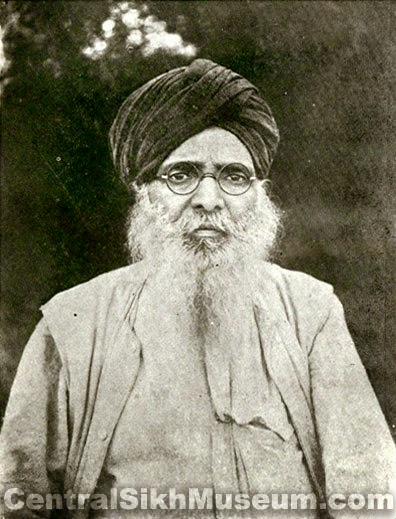
Baba Gurdit Singh - a nice man who clearly had enough
These were British subjects, but many were under the scrutiny of the British government. At the time in India, the call had gone out for independence. Some men on the boat were members of the Ghada Party. They conducted revolutionary activities in central Punjab and attempted to organize uprisings against the British overloads.

One member was Gurdit Singh. In 1911 he raised his voice against forced labour. He wrote to the Government complaining against officials who forced poor villagers to work for them without remuneration, and when he received no response, he exhorted the people of his village to refuse to be subjected to forced labour.

He's the one that chartered a Japanese ship, Kamagata Maru in 1914 to go to Canada.The obstructions put up by the alien authorities and the hardships faced by its passengers turned them into staunch nationalists.When it was turned back and reached Calcutta, the passengers were not allowed to enter Calcutta, they were rather ordered to board a Punjab-bound train especially arranged for the purpose. They refused to do and many of the passengers were shot dead. Gurdit Singh escaped and remained underground for many years till in 1920 on the advice of Mahatma Gandhi he made a voluntary surrender and was imprisoned for five years. After his release he settled down at Calcutta where he died in 1954.
Why did he do what he did? One quote sort of lets us know:

Memorial in Punjab to the people and to Singh
“The visions of men are widened by travel and contacts with citizens of a free country will infuse a spirit of independence and foster yearnings for freedom in the minds of the emasculated subjects of alien rule.”
~ Gurdit Singh