Thursday, 21 August 2014

History Making News: Uppity Historians, Heritage Blown, and Dirty Dancing


Historians Against the War

This week, I'd like to round up some cool stories for you where history or historical studies are getting some press.

First, some shit disturbing historians. Historians Against the War are a group started in 2003 at the American Historical Association meeting, as a way for historians to protest against American involvement in Iraq. They are against any American involvement in war. Right now, they are coming out against the ongoing attacks on civilians in Gaza and in Israel. They've created a petition to the president online, and so far have 200 signatures. They fully understand the US's role to play in this:
We also recognize the disproportionate harm that the Israeli military, which the United States has armed and supported for decades, is inflicting on the population of Gaza.We are profoundly disturbed that Israeli forces are killing and wounding so many Palestinian children...we call upon you to demand a cease-fire, the immediate withdrawal of Israeli troops from Gaza, and a permanent end to the blockade so that its people can resume some semblance of normal life. We urge you to suspend US military aid to Israel, until there is assurance that this aid will no longer be used for the commission of war crimes.
This is a very controversial take on the US support of Israel, and as usual, no one in the media except History News Network will even report on this.
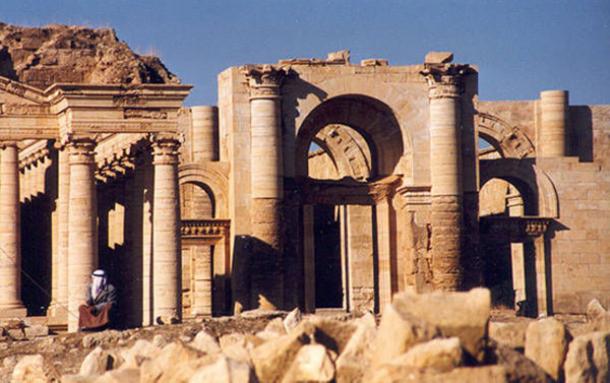

Hatra temples
Your days are numbered, evil UNESCO world heritage site! Hatra temple next on ISIS hit list?

For my second story, let's stay with the dark side of humanity, shall we? ISIS is not just satisfied with killing Christians in Iraq and Syria, because they are insane as hell. No, they want to blow up cultural and historical sites as well, because they know that once you destroy people's culture and history, you destroy their knowledge and spirit, and can bend them to your will.

Islamist militants’ attacks on cultural and historical treasures in Mosul — including a revered tomb of Joshua, has outraged many Muslim residents and stirred what appears to be the first spark of rebellion against the extremists’ harsh rule. ISIS apparently has also been planning the destruction of Christian monuments and relics as well, but so far have only wrecked a statue of the Holy Mary. But archaeologists think that the many Hatra temples in the area controlled by ISIS are next to get the burn and blow up treatment. See what happens when you create a power vacuum guys? Assholes like ISIS show up.And clearly their neighbours like Iran and Turkey could give a crap and help them out. So much for Arab unity.
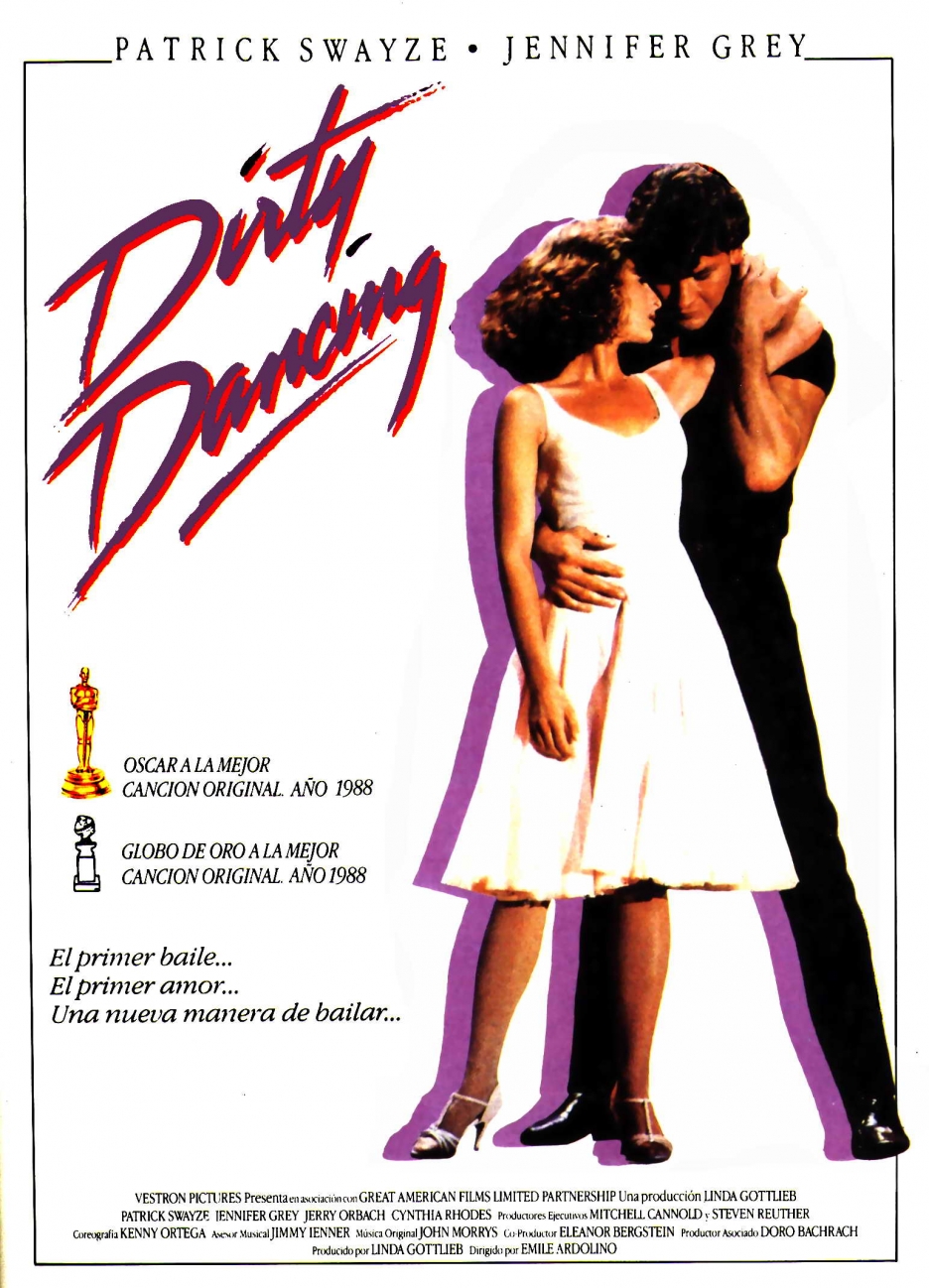

http://brogansblabbermouth.files.wordpress.com/2013/05/936full-dirty-dancing-poster.jpg
This is way hotter in Spanish.
Finally, how about something at least to make you smile.This week in 1987 we had the time of our lives. The movie Dirty Dancing opened August 21st. Because it's 25 years old, HuffPost did a five things you don't know bit about it. Pretty cool, since I forgot Dirty Dancing was written and co-produced by a woman. Eleanor Bergstein, based the film loosely on memories of her own life, including the dirty dancing part. Now 70, is busy mounting the stage version of the movie all over the world. But she confessed to the Telegraph that:
"We thought it was one of those movies that would go into the [movie] theatres for a few days and then straight to video, so we made it on a shoestring," she says. "We expected mockery, failure and disaster."

Her failure made an estimated $213 million, and still is a popular film with old folks like me, and the kids.Loved Patrick Swayze: RIP you fabulous man.


Monday, 11 August 2014

And All That Jass? - Questions From the Twitter-verse

This has to be my favourite question ever. I'm a huge fan of Jazz music, and love nothing better than to put on an album, or sing, jazz. A fellow fan, Laurie from Russia, sent me a note on twitter:
I love to play Jazz piano, but I don't know much about the history except the basics. One question I have is why do we call this music Jazz? Where did such a weird name come from? I can see why it's called the blues, but jazz? Thanks!
Hi Laurie! Thanks for the question, because you know how much I love etymology. First, the bad news. There's no consensus among scholars or musicians on who first coined it, when, or how. The good news: it's fuzzy origins makes the story much more interesting.


Sheet music from 1906, thanks to Dr. Lewis Porter for his research
The original spelling was Jass, and can be seen in early pictures of bands at the turn of the 20th century. One story is that it comes from the African languages. In the Congo, certain dances were called jasm or in the language Mandingo, jasi,  Many people reject these stories however. 


Buddy Bolden, with his horn, second from left at the top. He was the first cornetist and gave jazz its real earthy, upbeat and deep sound. He also developed schizophrenia, and was forgotten until historians started giving a crap.
The musical form we now call Jazz began in 1870s, and slowly emerged from blues, work songs, gospel and traditional European music. 'Jass' came from New Orleans, the birthplace of this music, and was a term probably coined by the local Creole musicians. Creoles are descended from White Europeans immigrating to the American South and African American taken as wives or who were slaves. These people had their own mix of European and African music. Jass in their slang meant "strenuous activity", usually of the sexual kind. 

They may have got this from their french ancestry. J. E. Lighter’s monumental Historical Dictionary of American Slang, includes an entry from an 1896 French-English glossary: “Jaser(or Jazer). To copulate.”
If the truth were known about the origin of the word 'Jazz' it would never be mentioned in polite society. - Clay Smith, jazz musician in "Étude," Sept. 1924
Another story, was that Jass was a name of the perfume used by the prostitutes of Storyville in New Orleans. Jazz musicians got their start in Storyville, playing to the whores dancing, because that was where they could get the best tips and get the best views.  But the story related by the great Jazz musician Winston Marsalis in the documentary, Jazz, was that it was about sex. The origins of the word relating to sex ring true to the culture surrounding the music. A great example of the sexual nature of jazz is the story of Creole musician Jelly Roll Morton. People laugh today and wonder why a father of Jazz music would name himself after a sweet roll. Ahem. He's not talking about a pastry, people. Jelly Roll was slang for the best sexual position a man could get with his penis. Typical jazz musician. He was awesome.


When did Jass become Jazz? The spelling seems to have changed very quickly, and by 1910 there change was complete in signs and advertisements used by bands. But many continued to use the old spelling, as seen in the record labels still using Jass.


This is the first jazz band that ever recorded, 1917, and they just didn't care how they spelt it!
The first time the term jazz appears in print was not in reference to music, but baseball. A pitcher for the Portland Beavers, Ben Henderson, was quoted in the Los Angeles times in April 2, 1912: "I got a new curve this year...I call it the jazz ball because it wobbles and you simply can't do anything about it." For Henderson to use the term jazz so casually, means it was already in the local vernacular of where he was from, as well as where he was interviewed. 

My final recommendation to Laurie and to everyone else: Go watch Jazz: A Film by Ken Burns. It is an amazing and important documentary on the history and power of jazz music. I found myself tapping my feet and singing along the whole time.


Monday, 4 August 2014

An Update On My Tumblr Experience...


While trying to figure out the world of the internet, I found out that all the hip young people are NOT on Facebook. Facebook is for us already over the hill in our 40s crowd who still think that the coolest invention is the toaster over. Or it's just me.

Anyhow - I'm on Tumblr and Twitter now too. So I'll be posting more cool historical content I see around the web, links to articles exctra, but writing actual blog content here. Because I tried Tumblr and it seems images work better.

Enjoy!


Sunday, 3 August 2014


Learn More! A History Round Up of the Best From the Web


lars
This week, real life too over and killed any interest in writing. Real life and some dodgy medication. But I did do a lot of 'surfing the web' as all the cool kids in my geriatric ward call it. I did discover some amazing historical articles and info from the web, and here's some highlights!

Learn more about...war!


Inventories of War

Photographer Thom Atkinson complied a gallery of what a soldier's kit and equipment for war would look like across time. With help from historians, museums, re-enactment societies, and soldiers, Atkinson laid out and shot pictures of kits from 1066's Warrior outfit to a Sapper's gear in 2014. One of the main things to look for in these pictures is how little the basic need for food and entertainment items has changed.

Obscure Wars

I'm not usually a fan of lists for lists sake, but this Chicago Tribune list of Obscure Wars is a pretty good info dump that you can go bounce off of to google and find out more about these silly wars, including the Jaybird-Woodpecker War of the USA, or the 12-year War of the Oaken Bucket, when thousands of people died because a bucket was stolen. Seriously.
http://ts1.mm.bing.net/th?id=HN.608002687424136968&pid=15.1
A bucket similar to this one caused a war. No I'm not drunk but those people must have been.

Learn more about...Computers!


The Computer History Museum

I found this gem while I was trying to figure out when ARPANET began (1962). While this site is a gateway to the museum in California, it has some great on-line exhibits on  the first 2000 years of computer history, their PDP-1 restoration project, and a This Day in History section. A very cool site to get your history bytes from. (ohhhh...me so funny.)
Like today - August 3, 1977 - Radio Shack released the TSR-180, their first computer release. I had a Tandy 1000 I still miss...

Learn more about....sports!


The Commonwealth Games

The last ten days I've been following the Glasgow 2014 games, mostly because it was my Great-Grandad's home town, and I like these much better than the overblown Olympics to watch. The first one was held in Hamilton, Ontario in 1930, with only 400 people competing. over 4500 athletes are participating in this year's games. This years were of course declared the best ever, and Canada did well, placing 3rd in the medal standing.

Will we see anymore Tunnock's tea cakes in the closing ceremony?
But I don't think dressing as a shinny donuts or dancing candies is a good way to end it.

And on that note, I'm off to actually write a very overdue article for Eden Keeper, which does not involve the dance of the gum drops.

Sunday, 20 July 2014

Medical Matriarchs: The First Female Physicians

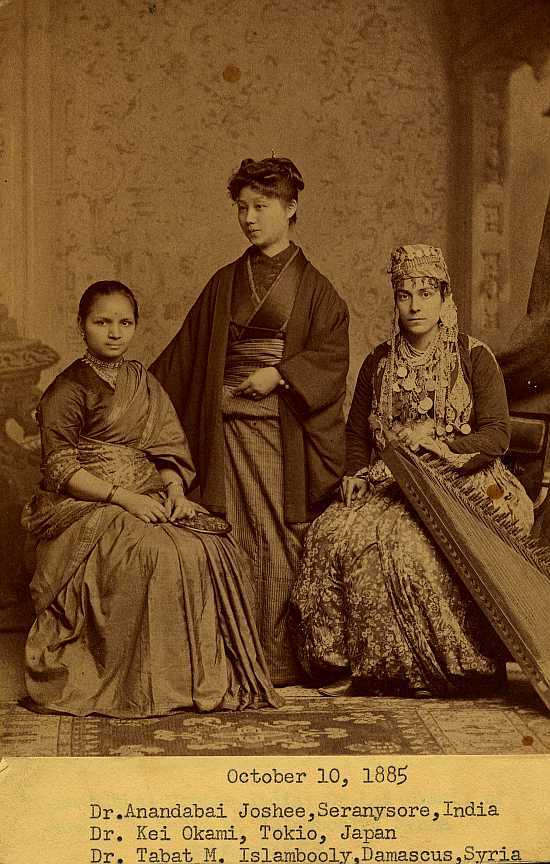
I just read a great article on three female Western medical physicians. Anandibai Joshi, Keiko Okami, and Sabat Islambouli eventually became among the first licensed female doctors in their respective countries: India, Japan and Syria. The picture above is so beautiful. It was due to the university they attended, run by Quakers, that these ladies were able to obtain their education.
women doctors 1885
The picture of awesome.
It made me want to find out who, if history knows, was the first actual female physician in recorded history. While women played so many roles in medicine as healers, I wanted to know when the term physician was first used in regards to a female healer. So I dragged out a couple of old history of medicine books I have and found two that I found interesting.

First, the term physician is problematic, as the etymology suggests:
early 13c., fisicien "a healer, a medical practitioner," from Old French fisiciien "physician, doctor, sage" (12c., Modern French physicien means "physicist"), from fisique "art of healing," from Latin physica "natural science" Distinguished from surgeon from c.1400. The ph- spelling attested from late 14c
To use the term in the ancient world, then, is based on the translation and their understanding of what a physician would be in that culture. To many, it has to be the first documented, societal accepted (example; licensed), and formally trained woman. The female doctors of Egypt fit this description. Being a doctor in Ancient Egypt was a big deal. It was a mix of spiritual practice, various healing methods, study and hard work. It was also open to both upper class men and women. They studied as apprentices to older physicians.

Step_pyramid_at_saqqara
Memphis and Saqqara - a resting place of an awesome woman.

Merit Ptah is believed by scholars to be the first physician ever named in history. Her name means "beloved of the God Ptah". Ptah was the god of creation, arts and fertility, so if this god was her namesake, she had a powerful ally. She lived sometime in 2700 BCE during the Old Kingdom in Egypt. All we know about Merit Ptah is from her tomb, found near Memphis in the huge burial ground of Saqqara. On her tomb, her son - a priest- wrote that she was the chief physician of the women. An impact crater on Venus is named after her, giving her even more immortality. We'll remember her long after what's their names of the cover of People this week.
Merit Ptah likeness in her sarcophagus - doctor's bag not shown.
Another probable first physician was Peseshet (ca. 2500). We only know about this female physician because there's a stela at Giza in the tomb of her son, Akhethetep, a high official. It says that says she was the overseer of doctors. She was probably a physician in her own right as well as a supervisor and administrator of an entire body of female physicians. At the time, many women worked at the medical school at Sais.
In her son's tomb, a possible picture of his mom: wonder if she had to beg for funding?

So why in this day and age do we care who the first women physicians are? The reason is that we need to celebrate anyone who bucks the norm. Most societies in the world, before and now, try to limit women's roles by denying them access to higher education, careers, and voting, using the excuse that they are just not capable or it's not womanly. Clearly these women stand out as arguments against that type of thinking, and we need to remember and honour that.

Book References I used and recommended:

Nunn, John F. Ancient Egyptian Medicine. University of Oklahoma Press: 2002.

Allen, James P. The Art of Medicine in Ancient Egypt. Metropolitan Museum of Art: 2005


Thursday, 17 July 2014

History Screws Everyone: the Israeli and Palestinian Conflict

This week's history question comes from deep in the heart of Saskatchewan, from Anna-Maria in Moose Jaw, "I don't get it: why does Israelis and Palestinians fight all the time? What's the history behind all this crazy crap?"

Let's look at one person's artistic interpretation:


A blunt and honest question, Miss Moose-Jaw. Right now, there's a lot of media interest in the area again as Hamas (who is in charge in Palestinian territory which includes the West Bank and the Gaza Strip) and Israel call a brief cease-fire after Israeli air strikes on a Gaza beach kills four Palestinian children. What the media is light on is historical events that have lead to about 2,000 people dying this year already in an area the size of my backyard. 
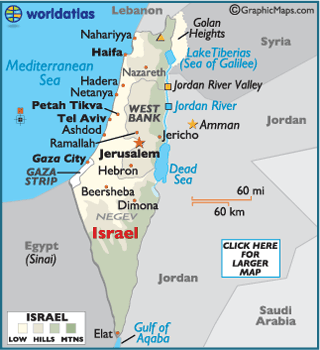
map of Israel
Not my backyard pictured.
So, gather around and I'll tell you one reason why things are so bad in Israel. Remember, history stories always end with "And a lot of people, Arabs, Jews...everyone - dies horribly and needlessly."

Once upon a time, there was an area called Palestine that was under the control of someone or another all the time: Cannanites, Assyrians, Romans, Crusaders, Mongols, and so forth. Everyone called it something different, but our story begins when this area was controlled by the Ottoman Empire since the 1500s. The people who lived there, mostly Arab Muslims, but Christians, Jews, and other groups as well, were not happy living under the Ottoman Turks because they treated them like lesser beings. You also have the Jewish people and the Pan-Arab movement looking at the area as their historical homelands. So there was a lot of tension. Then things got worse: a world war started.

You can blame a lot of the conflict today on British Imperialism after World War I.

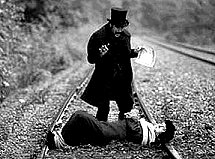
The promise of liberation from the Ottomans led many Jews and Arabs to support the allied powers during World War I, leading to the emergence of widespread Arab nationalism. The British promised that if the Arabs supported then in the war, the British government would support the establishment of an independent Arab state including Palestine, when they defeated the Turks. I can just see an evil old silent film era villain smiling and promising the world to the Arab people.

http://thelaymansanswerstoeverything.com/wp-content/uploads/2013/05/3Damsel.jpg
"We've got other plans for Palestine!"
A revolt, led by T. E. Lawrence (Lawrence of Arabia) and the Arab leader's son Faysal, was successful in defeating the Ottomans, and the British took control over the area including modern day Iraq and Palestine in 1917, along with France taking their chunk as well. The Arab people who fought so hard for their independence, were rightly pissed. Then the British decided to promise support for a Jewish "national home" in Palestine. The British sought legitimacy for their continued control of the region, which they got from the League of Nations in 1922. So, not only did the British screw them, but so did the rest of the world. Arab nationalists tried to revolt and created the Arab Kingdom of Syria in 1920, only to have crushed by the French.There was no way the British would give up anything either.

But look, you can have your own flag!
Under the British Mandate for Palestine, the land west of the Jordan River, known as Palestine, was under direct British administration, while the land east of the Jordan was a semi-autonomous region called Transjordan, which got independence in 1946. Jews began to immigrate (Zionist) once they heard of the British plan to create a homeland for them in the millions, and Palestinian Arabs saw this as being screwed out of their own homes. Again. They rioted in 1920, and in 1922 the British government tried to backpedal, saying they were not going to form a Jewish state.That really didn't help much as they knew how good the British were at keeping their word.

Riots broke out between the Jews and the Arabs, all leading to the huge 1936-39 Arab Revolt. Again the British wet their pants and tried to stop all Jewish immigrants. But now we come to the end of the road for many people: World War II and the Holocaust (Shoah) began and the Jews of Europe were being exterminated. The calls for a homeland continued as Jews fought with the British and many fled to Palestine illegally. Failing horribly to end the problems and economically broke from World War II, the British wanted and were informed by the UN to end their mandate over Palestine, and begged off the problem on the United Nations. The UN called for the creation of an independent Arab State, an independent Jewish State, and the City of Jerusalem. Well, that went over like a fart.
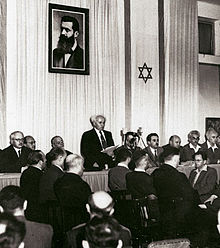
A man reads a document to a small audience assembled before him. Behind him are two elongated flags bearing the Star of David and portrait of a bearded man in his forties.
Leaders of Jewish Agency declaring the formation of Israel. No farts were reported.
The Arab League said no way, because they were being told again that their country was not under their control and they had to share. But the Jews said yes, because after the Holocaust you can bet they would say okay to anything, even if they had been given a birdhouse and told to live in it.

In 1948, the British gave up the area and the armies of four Arab countries—Egypt, Syria, Transjordan and Iraq—entered what had been British Mandatory Palestine, launching the 1948 Arab–Israeli War. Then things got really complex and that would be a really long story.

And a lot of people died, and continue to die, horribly and needlessly.

Thursday, 10 July 2014

Footie World Cup : The History of FIFA

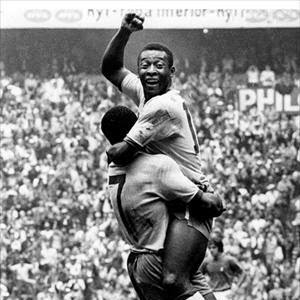
Even I know who Pele is.
I don't know much about football, or soccer to the barbarians in North America like me. I've been learning a lot as my mates at work extol the virtues of the very good look men, mostly with full heads of hair we've notice, that are shooting it out for the FIFA World Cup of 2014. Many are hard-core fans, who know every player, and have dragged me along on their enthusiasm. I cheered for Bosnia and Ecuador as my friends did, weep for Spain's humiliation, and cheered on Holland. 

But I have no idea about the history, or why my buddies were so passionate about this world cup.


First, a primer. FIFA (Fédération Internationale de Football Association) is a non governmental orgnaization, but governed by Swiss Law. (Those Swiss are pretty easy going I think so it would be pretty chill) It was started in 1904 because the increase in international matches led to many in Europe wanting an overall governing body. It was formed in Paris and France, Belgium, Denmark, Netherlands, Spain, Sweden and Switzerland all signed up. Germany soon joined after. This is interesting to me, as this time period everyone in Europe is sort of getting along, but very tentatively. England, after not wanting to join in at first, decided to join in a year later.

A great surprise to me, FIFA and the International Olympic Committee were in a pissing match with each other right from the start. Each wanted complete control over rights to stage football world championships. It took until 1920 for the two groups to agree and FIFA could even discuss having a world cup. The reason why FIFA wanted it so bad was, as FIFA governor Henri Delaunay stated:
"International [soccer] can no longer be held within the confines of the Olympics and many countries where professionalism is now recognized and organized cannot any longer be represented there by their best players."
The IOC finally relented and in 1928, planning began for the first World Cup in 1930. Uruguay was granted the first Cup as it knew how to sweeten the pot: it offered to pay for the other countries travel and hotel expenses, and they would build a band new stadium. To their delight, Uruguay also won the first world cup. Two more would be held until World War Two started and wrecked all the good times.

And the traditions of guys with great hair begins.

The World Cup started back up again in 1950 and is now held every four years, just like the Olympics. And just like the Olympics, politics and egos often got in the way.

1966:  England and West Germany were fighting it out in London. England won their first and only World Cup with a 4-2 after extra time. The controversy was that the third goal by the English hit the underside of the cross bar, bounced down on the line and was cleared. They officials deemed it good. much to many people's bitterness as they thought it broke the rule that it should go over the line, in their mind. People still whinge about it today.

1973:  The Soviet Union versus Chile was a political and sad nightmare. The two countries were vying for a spot for the play offs. They were supposed to play in November Santiago in their stadium, where two months before the new dictator of Chile Augusto Pinochet had executed people. the Soviets asked for a different venue, and when no one would agree to a move, they refused to take to the field, and were disqualified. The Chileans did show up to play. This shows to me that that team had some serious moral and ethical soccer balls and we should really hear more about this.

Prisoners at the stadium two months before the match: yeah, no.
Today, FIFA has 209 member associations with the goal of the constant improvement of football int eh world. It's mission is to develop football everywhere and for all, to organize inspiring tournaments, and care about society and the environment. as:
"Football is much more than just a game. Its universal appeal means it has a unique power and reach which must be managed carefully. We believe that we have a duty to society that goes beyond football: to improve the lives of young people and their surrounding communities, to reduce the negative impact of our activities and to make the most we can of the positives."
Sport versus social needs: so not everyone's a fan in Brazil?
Now, If you will excuse me, I need to see how Argentinians have done against the Netherlands. I'm sure there will be a pop quiz at work.

More on Football:

The politics of the sport and FIFA are discussed well at Soccer Politics

Check out more history at Sportsnet's great primer on the history of FIFA.

Here's a great list of every world cup winner at the football bible site.