Monday, 20 October 2014

Cundill Prize: Serious Money for Serious History

This year's nominees for The Cundill Prize in History was announced this month on October 2. This is serious money at $75,000. It is the richest prize for historical writing in the world, and issued annually. Two 'Recognition of Excellence' Prize of US$10,000 are also given. The award is:

...coordinated by the McGill Institute for the Study of Canada (MISC) on behalf of the Dean of Arts, was established in 2008 to be offered each year by McGill University (Montreal, Canada) to an individual, of any nationality and from any country, who has published a book determined to have had (or likely to have) a profound literary, social and academic impact in the area of history.


Gary Bass for The Blood Telegram: Nixon, Kissinger and a Forgotten Genocide. Ugh. Well written but crap on a cracker I'm done with Nixon and how he and the 1960s changed the world blah blah blah.

David Brion Davis for The Problem of Slavery in the Age of Emancipation. Awesome, asked hard questions like how it kept happening. Not for the faint of heart.

Andrew O’Shaughnessy for The Men Who Lost America: British Leadership, the American Revolution, and the Fate of the Empire. Never read it. Good luck.

Richard Overy for The Bombing War: Europe 1939-45 . ZZZZZZZZZZZZZZZ...oh sorry. Ummm you say this is a new take on an old topic. Ok. Sure.

David Van Reybrouck for Congo: The Epic History of a People. Read this with King Leopold's Ghost and you will understand why that region is so fucked up now. Hope this wins.

Geoffrey Wawro for A Mad Catastrophe: The Outbreak of World War I and the Collapse of the Habsburg Empire. LOVED IT!!! A must read. Why? Because it rounds up in a well written and actually understandable narrative the truly screwed up mess of pre-war Europe and the severely dysfunctional Empire leading to a war that never should have happened.

The three finalists for the Cundill Prize in Historical Literature be announced in mid-October. The grand prize winner will be announced at a Toronto awards ceremony on Thursday, Nov. 20.
The prize is named after F. Peter Cundill, a very wealthy investor, who decided that it was time to recognize and promote literary and academic achievement in history. In 2008, he created the Cundill Prize. He unfortunately died in 2011, but his estate keeps it going. I wish I could ask him why did they name it after him, and not some famous historian? I'd suggest the awesome Marie Therese Veronica "Terry" Goulet, a Metis historian, but maybe I am living in a fantasy world where we acknowledge publicly there's brilliant First Nations/Metis in our country. (Just sayin') 


Mini rant over...for now.

Sunday, 12 October 2014

Swing Batter Batter Batter: 1924 World Series on Film

For someone who is not the sporty type, I'm really stepping out of my comfort zone. First, I join the gym. Love it. Second, I write about the history of sport riots last week. Now I'm thinking of the history of Yoga as a piece. But then I read that ninety year old (1924) World Series footage was found in the rafters of a house this week, and the old love of baseball history came back to me. Early in my reading life, I read anything that had to do with the White Sox scandal, and branched out from there. So of course I had to read up on the year, the game and the players from that day in 1924.

You can watch the film here, thanks to the Library of Congress. Which, by the way, has a website of all sorts of awesome stuff you can get lost in.

America in 1924:

Walter Johnson greeting President Calvin Coolidge, and a tiny other man.
1924 was a good year for a lot of people in America. The arts and sciences are enjoying a upswing as Rhapsody in Blue by Gershwin is performed for the first time. IBM is founded in New York.The film company MGM is formed. It's good for women: Nellie Tayloe Rose was elected the first woman governor of Wyoming. It's not so good if you happen to be a miner. 172 miners die when the Castle Gate mine in Utah collapses. It appears that if you're a member of the working classes in 1924, you were screwed.

The Game:

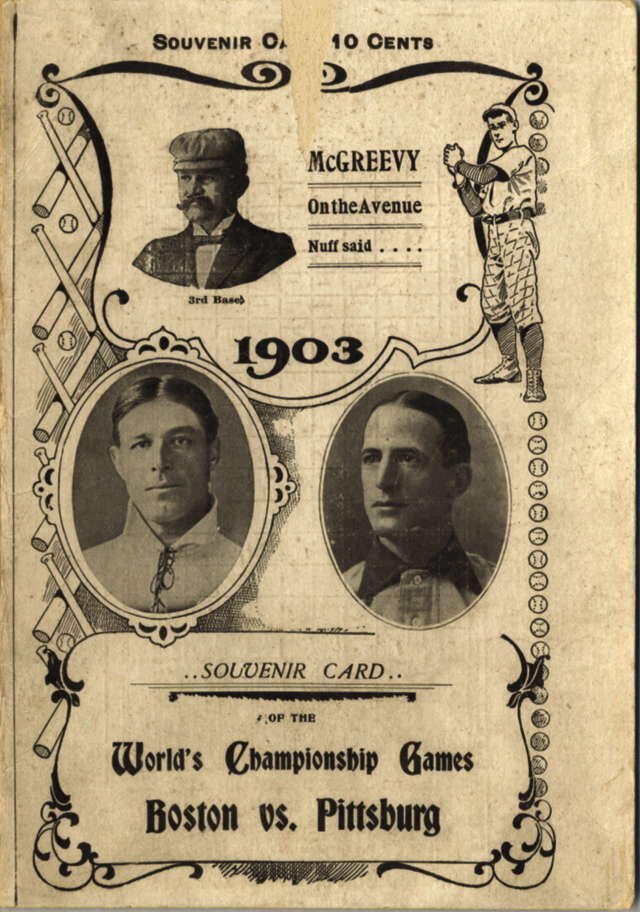
1903 World Series scorecard cover
I can smell the peanuts now!
This was not the first world series, and it's a miracle there even was one. In 1901, there were so many baseball leagues running around and trying to cut into the other league's business, the sport was a mess. They raided eachother's star players. Each league had their own championship as well which got the fans confused, and money divided. The leagues finally called a truce in the winter of 1902–03 and formed the National Commission to preside over organized baseball. The following season, the Boston Americans and Pittsburgh Pirates had secured their respective championship pennants by September. The two winning teams of the National and American league agreed to a voluntary  best-of-nine championship, with the first three games played in Boston, the next four in Pittsburgh, and the remaining two (if necessary) in Boston. There was no 1904 series, but in 1905 the two leagues agreed to have a yearly tournament for someone to hold the title of World Series winners.


A Notable Player:


http://ghostsofdc.wpengine.netdna-cdn.com/wp-content/uploads/2013/03/1047fu.jpg
Barney in 1907
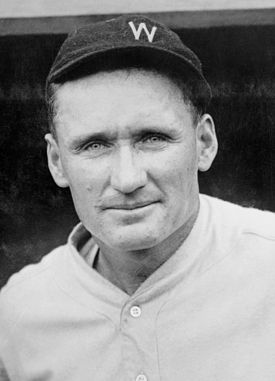
Walter Johnson 1924.jpg
Johnson in 1924
One of the players on the field that day was the great Walter “Big Train” Johnson (1887-1946). He was called "big train" for his incredible control and speed as a pitcher, but his other nickname was a bit weird: Barney. As a young man I can see it, look at his rookie card at the beginning of his career in 1907! Johnson won 416 games in his career, the second most in history, on teams of the Washington Senators that were simply awful. He did pitch the Washington Senators to the World Series title in the1924.

Johnson was amazing: throughout his career he threw 110 shutouts, the most in history and struck out a then record 3,508 batters, mostly with a blazing fastball that became his trademark. His pitching career lasted 21 years, ending in 1927. He then became a manager for the Senators from 1929 to 1932, then the Cleveland Indians from 1933 to 1935. In the book Walter Johnson: Baseball's Big Train, many recall how Johnson was a very gentle, good tempered man, had lots of friends in baseball, and someone who tried to keep his powerful pitch in check for fear of hurting others. The so-called great ballplayers today could learn a bit from Big Train.