Monday, 20 October 2014

Cundill Prize: Serious Money for Serious History

This year's nominees for The Cundill Prize in History was announced this month on October 2. This is serious money at $75,000. It is the richest prize for historical writing in the world, and issued annually. Two 'Recognition of Excellence' Prize of US$10,000 are also given. The award is:

...coordinated by the McGill Institute for the Study of Canada (MISC) on behalf of the Dean of Arts, was established in 2008 to be offered each year by McGill University (Montreal, Canada) to an individual, of any nationality and from any country, who has published a book determined to have had (or likely to have) a profound literary, social and academic impact in the area of history.


Gary Bass for The Blood Telegram: Nixon, Kissinger and a Forgotten Genocide. Ugh. Well written but crap on a cracker I'm done with Nixon and how he and the 1960s changed the world blah blah blah.

David Brion Davis for The Problem of Slavery in the Age of Emancipation. Awesome, asked hard questions like how it kept happening. Not for the faint of heart.

Andrew O’Shaughnessy for The Men Who Lost America: British Leadership, the American Revolution, and the Fate of the Empire. Never read it. Good luck.

Richard Overy for The Bombing War: Europe 1939-45 . ZZZZZZZZZZZZZZZ...oh sorry. Ummm you say this is a new take on an old topic. Ok. Sure.

David Van Reybrouck for Congo: The Epic History of a People. Read this with King Leopold's Ghost and you will understand why that region is so fucked up now. Hope this wins.

Geoffrey Wawro for A Mad Catastrophe: The Outbreak of World War I and the Collapse of the Habsburg Empire. LOVED IT!!! A must read. Why? Because it rounds up in a well written and actually understandable narrative the truly screwed up mess of pre-war Europe and the severely dysfunctional Empire leading to a war that never should have happened.

The three finalists for the Cundill Prize in Historical Literature be announced in mid-October. The grand prize winner will be announced at a Toronto awards ceremony on Thursday, Nov. 20.
The prize is named after F. Peter Cundill, a very wealthy investor, who decided that it was time to recognize and promote literary and academic achievement in history. In 2008, he created the Cundill Prize. He unfortunately died in 2011, but his estate keeps it going. I wish I could ask him why did they name it after him, and not some famous historian? I'd suggest the awesome Marie Therese Veronica "Terry" Goulet, a Metis historian, but maybe I am living in a fantasy world where we acknowledge publicly there's brilliant First Nations/Metis in our country. (Just sayin') 


Mini rant over...for now.

Sunday, 12 October 2014

Swing Batter Batter Batter: 1924 World Series on Film

For someone who is not the sporty type, I'm really stepping out of my comfort zone. First, I join the gym. Love it. Second, I write about the history of sport riots last week. Now I'm thinking of the history of Yoga as a piece. But then I read that ninety year old (1924) World Series footage was found in the rafters of a house this week, and the old love of baseball history came back to me. Early in my reading life, I read anything that had to do with the White Sox scandal, and branched out from there. So of course I had to read up on the year, the game and the players from that day in 1924.

You can watch the film here, thanks to the Library of Congress. Which, by the way, has a website of all sorts of awesome stuff you can get lost in.

America in 1924:

Walter Johnson greeting President Calvin Coolidge, and a tiny other man.
1924 was a good year for a lot of people in America. The arts and sciences are enjoying a upswing as Rhapsody in Blue by Gershwin is performed for the first time. IBM is founded in New York.The film company MGM is formed. It's good for women: Nellie Tayloe Rose was elected the first woman governor of Wyoming. It's not so good if you happen to be a miner. 172 miners die when the Castle Gate mine in Utah collapses. It appears that if you're a member of the working classes in 1924, you were screwed.

The Game:

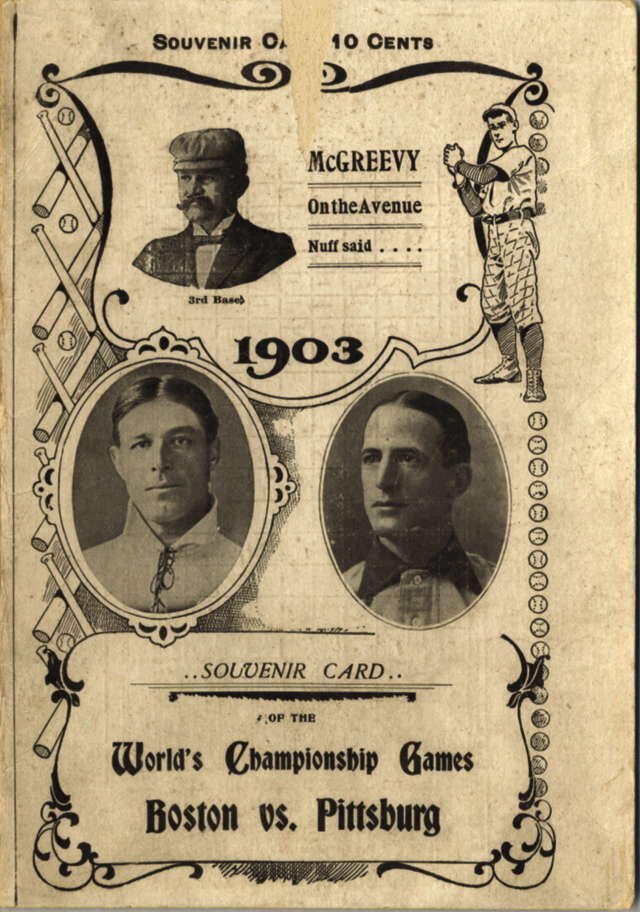
1903 World Series scorecard cover
I can smell the peanuts now!
This was not the first world series, and it's a miracle there even was one. In 1901, there were so many baseball leagues running around and trying to cut into the other league's business, the sport was a mess. They raided eachother's star players. Each league had their own championship as well which got the fans confused, and money divided. The leagues finally called a truce in the winter of 1902–03 and formed the National Commission to preside over organized baseball. The following season, the Boston Americans and Pittsburgh Pirates had secured their respective championship pennants by September. The two winning teams of the National and American league agreed to a voluntary  best-of-nine championship, with the first three games played in Boston, the next four in Pittsburgh, and the remaining two (if necessary) in Boston. There was no 1904 series, but in 1905 the two leagues agreed to have a yearly tournament for someone to hold the title of World Series winners.


A Notable Player:


http://ghostsofdc.wpengine.netdna-cdn.com/wp-content/uploads/2013/03/1047fu.jpg
Barney in 1907
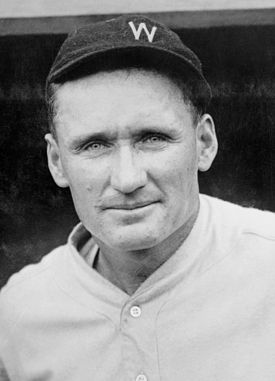
Walter Johnson 1924.jpg
Johnson in 1924
One of the players on the field that day was the great Walter “Big Train” Johnson (1887-1946). He was called "big train" for his incredible control and speed as a pitcher, but his other nickname was a bit weird: Barney. As a young man I can see it, look at his rookie card at the beginning of his career in 1907! Johnson won 416 games in his career, the second most in history, on teams of the Washington Senators that were simply awful. He did pitch the Washington Senators to the World Series title in the1924.

Johnson was amazing: throughout his career he threw 110 shutouts, the most in history and struck out a then record 3,508 batters, mostly with a blazing fastball that became his trademark. His pitching career lasted 21 years, ending in 1927. He then became a manager for the Senators from 1929 to 1932, then the Cleveland Indians from 1933 to 1935. In the book Walter Johnson: Baseball's Big Train, many recall how Johnson was a very gentle, good tempered man, had lots of friends in baseball, and someone who tried to keep his powerful pitch in check for fear of hurting others. The so-called great ballplayers today could learn a bit from Big Train.

Saturday, 27 September 2014

History of Sport Riots or I Hate Your Team So You Must Die!


I was flipping through some old articles I've written, and I found one I did asking why in June of 2011 did the Stanley Cup hockey riot in Vancouver occur. I wanted to write it off as a bunch of drunk a-holes, but the reality was more sinister.
Vancouver Canucks fans pose in front of a burning police cruiser during a riot following game 7 of the NHL Stanley Cup final in downtown Vancouver on June 15.
Exhibit A - A is for Asshole. Ironic he's wearing a superman shirt.
The riot began after the Vancouver Canucks' lost the Stanley Cup final to the Boston Bruins. Cars were burned, shop fronts were destroyed, and people very beaten. Over 100 people have been charged to date. The cost to the city is about 1.3 million dollars in damages. The city called for a enquiry into the riot and why it began, with the verdict being that people weren't bussed out of the area properly, drunkenness, police action and crowd mentality.

This incident is part of a long history of sport related riots. All share some similar patterns: lots of people, too much partying, and the bizarre personal ownership that people take on of their teams. It's nuts in my opinion, but crazy stuff makes interesting history!
A charioteer, the football stars of the 500s. Hot with that helmet!
In the ancient world, chariot races were popular spectacles with thousands attending the events. Fans would become personally invested in one team and would form gangs to attack the rival team’s supporters. The most well known riot was the Nika Riot in Constantinople in 532 CE.  It started with crazy chariot racing fans. There were four different factions who all hated each other, but the Green and the Blue teams were the most politically active and tried to influence the Byzantium government. A couple were captured and charged with murdering some of their opposition. Pissed at their attempts, the Emperor Justinian ordered their death, but the two gangs demanded full pardons for these men. When their demands were not met, they set the city ablaze.

At the same time a chariot race was going on at the Hippodrome, organised by the green and blues to raise support for overthrowing the emperor. People began to shout ‘Nika’ meaning victory or conquer in Greek. But Justinian ordered the army to stop the riots. The rioters were trapped inside the Hippodrome and it is estimated between 10,000 and 30,000 people were killed. And that's why sports and politics shouldn't mix.

Saskatchewan Rough Riders fan at a Canadian Football League game. Do you want these guys in politics?
Despite the Nika Riots, violence at sporting events was very rare for centuries. Occasional incidents would occur but without the political goals and level of extreme violence. The Cricket Riot of 1879 occurred when a team of English cricketers played a series of matches against the home team in New South Wales, Australia. The English referee called out a local hero, which incensed the 2,000 fans who ran out onto the pitch and began attacking the English team and the refs. The game was cancelled but resumed the next day. No one died, but it was still pretty crazy. I think a little bit of this was due to Australians being seen as less-than, and anti-colonial behaviours. 
http://ts4.mm.bing.net/th?id=HN.608052547753084287&pid=15.1
One of the few pictures of a cricket riot in the 1920s, cause you know it's cricket!
In the Twentieth century, the fan violence increased with countless deaths as a result. One of the worst riots in modern history was the 24 May 1964 soccer riot in Lima, Peru. Peru and Argentina played an Olympic qualifying match at the National Stadium. A great deal of rivalry existed between the two teams and the Peruvians were desperate for a win. The referee disallowed a Peruvian goal in the final two minutes of the game and they lost. The crowd went wild with people panicking to get away from the violence. It caused a stampede which killed 318 people and injured 500.


Which brings me back to my original question: why do people riot at sporting events? It varies but the psychology of it is interesting. When we're less accountable and anonymous, we tend to behave in ways we wouldn't. Also that fan identification with sports teams is psychologically important for many people, particularly in our increasingly transient and insular society. While alcohol is also often cited for its role in such incidents, these two reasons above are deemed much more important.

http://ts4.mm.bing.net/th?id=HN.607996313750210363&pid=15.1
Remember that next time you riot, cricket fans!

Wednesday, 17 September 2014

History of Women in Science: Annie Cannon and her love of the stars

Physics lab of Sarah Whiting, ca. 1896
Wellesley College Science Lab 1895: Attitude Created Here.
I just finished watching an episode of Cosmos with Neil deGrasse Tyson titled "Sisters of the Sun" on three pioneers in astrophysics: Cecilia Payne, Annie Jump Cannon and Henrietta Leavitt. Comments from the web were positive as the series needed to profile some important women scientist. While the episode gave a great overview, let's look a bit more at these three kick ass women.

Today's blog is all on Annie Cannon. (1863-1941)


 Picture of Annie Jump CannonWhat was her education like?

A rough go at the start. She had hearing damage from fever as a young girl, but in no way did she let it stop her. Annie's interest in astronomy was first sparked as a young girl, when her mother taught her the constellations. She also realized her daughter was super brilliant and told her to go to college and major in science.

At the all women Wellesley College she pursued these interests, learning physics, astronomy, and how to make spectroscopic measurements: the colours of the stars. She then graduated from Wellesley with a degree in physics (1884), became a “special student” of astronomy at Radcliffe College (1894), M.A. from Wellesley College (1907), and was the first woman to receive a doctor of astronomy degree from Groningen University (1921). What really blew everyone away was that she was the first woman to receive an honorary degree from Oxford (1925).

Why is she so kick ass? 


Because she was on the team of women who mapped and defined every star in the sky they could photograph. And she appears in a Wonder Woman Comic.

Seen in Wonder Woman #44, because she was that awesome.

Doctor Cannon became the world's expert in stellar classification, as well as developing and fine-tuning the Harvard system of classification that is studied by astronomy students today. She started by examining the bright southern hemisphere stars. To these stars she applied her system, a division of stars into the spectral classes O, B, A, F, G, K, M. Her scheme was based on the strength of the absorption lines were understood in terms of stellar temperatures, her initial classification system was rearranged to avoid having to update star catalogues.Cannon published her first catalogue of stellar spectra in 1901.

What was she like? 


540713_10151878214352598_1767376038_n
Cause her nature meant business.
A serious scholar, very neat and tidy, and the brains of a giant. According to her own journals she was passionate about science, a serious worker, and wanted to accomplish great things with her life. She really hated living at home after she graduated the first time, so she found work at Radcliffe, then Wellesley, and then in 1896 was hired by Professor Edward Charles Pickering, director of the Harvard College Observatory where she spent the rest of her career until she retired in 1940.

She travelled extensively, entertained many guests, wrote letters avidly and was an accomplished pianist. She was also an advocate for women's suffrage and a member of the National Women's party.  Late in life Cannon said, “In our troubled days it is good to have something outside our planet, something fine and distant for comfort.”
 
FYI - On Active History this week is a great interview about women in engineering sciences. A must listen!

When you want to know more - head on over to this great bibliography of women in astronomy.

Monday, 8 September 2014

She's Got It: Pin Ups Before World War Two

My question today comes from the twitters online: "Were pin up girls invented during the Second World War in the1940s or did they have them in World War I?"

French Postcards
What your great-grandad went to war for.
As long as there has been eyes, there have been pin up girls, in art and photography. Pin ups implies the type of girl pictures up somewhere so you could look at her all the time, hence the name. That term did not come into use until the 1940s. There are many girl pictures pre-1940s however that would have caught the notice of the men in the first World War.

The concept of mass produced pictures of ladies in various states of undress were popular advertisements among burlesque performers in the 19th century. An example of this are Boudoir Cards, almost exclusively from France, that the young men in the trenches could look at. The French were not so worried about the naked female form as other countries, but they still had to be sold under the table. One very popular model was Fernade Barrey, who we know very little about. Postcards from the 1910s state that she was a courtesan who used the cards to advertise.

Another kind of pin up was Bathing Beauties, pictures and films that were focused on pretty girls who wore bathing suits. Mack Sennett, a Canadian filmmaker and founder of Keystone studios, was a major player in early comedies, giving us the pie in the face jokes and those Keystone cops running around like mad. He also in 1915 gave the world girls showing their knees:


These bathing beauties and their pictures were very popular until their end in 1928. These were mild compared to the new genre of nudist publications that surfaced. The idea of linking sex and humour, a component of pin-ups, and using drawings to illustrate their stories and jokes evolves during the early 1930's. As well, a much more graphic female body was now being drawn, compared to earlier "oh my god I saw her ankle" photos that the general population was seeing. Major artists including George Petty and Alberto Vargas created calendar girls that very soon adorned the walls of garages and workshops everywhere. 

Earl MaPherson's work late 1930s, because you really need a calendar that small...

 For some amazing pre-war pin ups, check out pinterest, oddly enough.

Monday, 1 September 2014

William Haines: A Brave Gay Man in Hollywood

This week was Pride Week in my hometown, and I volunteered as I always do for the Calgary's Queer History Project booth. I was speaking to a friend about the current acceptance of gay and lesbian actors in Hollywood and she asked me if I knew who the first one that was 'out'.

I do, but only because I recently read a really good book Wisecracker: The Life and Times of William Haines, Hollywood's First Openly Gay Star. William (Billy) Haines (1900-1973) was a silent-screen movie idol. Good looks, decent acting, and a sharp tongue won him a host of fans.
William "Billy" Haines (1900-1973), silent film actor-turned-decorator to the stars - photo by Edward Steichen
I can't see why they thought he was hot in the 1920s, no not at all.
He started out in 1922, by sending his photograph to a "New Faces" contest sponsored by movie producer Samuel Goldwyn. Haines won and started his film career under contract with Goldwyn's MGM but was loaned out to other studios. His break out came with Brown of Harvard (1926) with Joan Crawford, who became a life long friend. Haines was named a top-five box office star from 1928 to 1932. He was known for being seriously hot, funny, and a smart-ass.

Then he fell in love. On a trip to New York in 1926, Haines met James "Jimmie" Shields. He convinced him to move to Los Angeles with him, where he could get him work as an extra. Shields agreed. They became a couple and stayed together for the next 40 years, until Haines death. Joan Crawford once remarked that they were the happiest married couple in Hollywood.

From left: Shields, Haines, Joan Crawford, and unknown dude in the 1940s. I love men in black tie.
While his friends had no problem with him being gay, the rest of the country had issues. In the 1920s, homosexuality and sexuality for many in big urban areas was to be celebrated. The puritanical-ism of the depression in the 1930s things changed. In 1933, Haines was arrested with a sailor he had picked up. The MGM studio head Louie B Mayer informed him that either he agree to a sham marriage or a lavender marriage, end his relationship with Shields, or his career was over.

Haines was awesome. He refused to deny his homosexuality.

He rejected Hollywood hetro-normative demands and decided to leave acting. Using his connections, Haines became an interior designer, creating furniture and designing beautiful homes for the rich and famous in Hollywood. But don't let that fool you into thinking they just gave him work. Haines was one of the best ever and became a legend in the design world. His furniture is still in demand, with two chairs having been sold recently for $43,000.

Don't think his life was easy. He and his partner were beat up at least on one occasion in 1936 by an angry mob of reportedly white supremacists from their home. No charges were laid, of course. The couple settled in Brentwood, California. Haines died of lung cancer at the age of 72. A sad ending note, however. His life partner Shields could not live without him, and committed suicide soon after.

Rest in peace, you magnificent man.


Thursday, 21 August 2014

History Making News: Uppity Historians, Heritage Blown, and Dirty Dancing


Historians Against the War

This week, I'd like to round up some cool stories for you where history or historical studies are getting some press.

First, some shit disturbing historians. Historians Against the War are a group started in 2003 at the American Historical Association meeting, as a way for historians to protest against American involvement in Iraq. They are against any American involvement in war. Right now, they are coming out against the ongoing attacks on civilians in Gaza and in Israel. They've created a petition to the president online, and so far have 200 signatures. They fully understand the US's role to play in this:
We also recognize the disproportionate harm that the Israeli military, which the United States has armed and supported for decades, is inflicting on the population of Gaza.We are profoundly disturbed that Israeli forces are killing and wounding so many Palestinian children...we call upon you to demand a cease-fire, the immediate withdrawal of Israeli troops from Gaza, and a permanent end to the blockade so that its people can resume some semblance of normal life. We urge you to suspend US military aid to Israel, until there is assurance that this aid will no longer be used for the commission of war crimes.
This is a very controversial take on the US support of Israel, and as usual, no one in the media except History News Network will even report on this.


Hatra temples
Your days are numbered, evil UNESCO world heritage site! Hatra temple next on ISIS hit list?

For my second story, let's stay with the dark side of humanity, shall we? ISIS is not just satisfied with killing Christians in Iraq and Syria, because they are insane as hell. No, they want to blow up cultural and historical sites as well, because they know that once you destroy people's culture and history, you destroy their knowledge and spirit, and can bend them to your will.

Islamist militants’ attacks on cultural and historical treasures in Mosul — including a revered tomb of Joshua, has outraged many Muslim residents and stirred what appears to be the first spark of rebellion against the extremists’ harsh rule. ISIS apparently has also been planning the destruction of Christian monuments and relics as well, but so far have only wrecked a statue of the Holy Mary. But archaeologists think that the many Hatra temples in the area controlled by ISIS are next to get the burn and blow up treatment. See what happens when you create a power vacuum guys? Assholes like ISIS show up.And clearly their neighbours like Iran and Turkey could give a crap and help them out. So much for Arab unity.


http://brogansblabbermouth.files.wordpress.com/2013/05/936full-dirty-dancing-poster.jpg
This is way hotter in Spanish.
Finally, how about something at least to make you smile.This week in 1987 we had the time of our lives. The movie Dirty Dancing opened August 21st. Because it's 25 years old, HuffPost did a five things you don't know bit about it. Pretty cool, since I forgot Dirty Dancing was written and co-produced by a woman. Eleanor Bergstein, based the film loosely on memories of her own life, including the dirty dancing part. Now 70, is busy mounting the stage version of the movie all over the world. But she confessed to the Telegraph that:
"We thought it was one of those movies that would go into the [movie] theatres for a few days and then straight to video, so we made it on a shoestring," she says. "We expected mockery, failure and disaster."

Her failure made an estimated $213 million, and still is a popular film with old folks like me, and the kids.Loved Patrick Swayze: RIP you fabulous man.